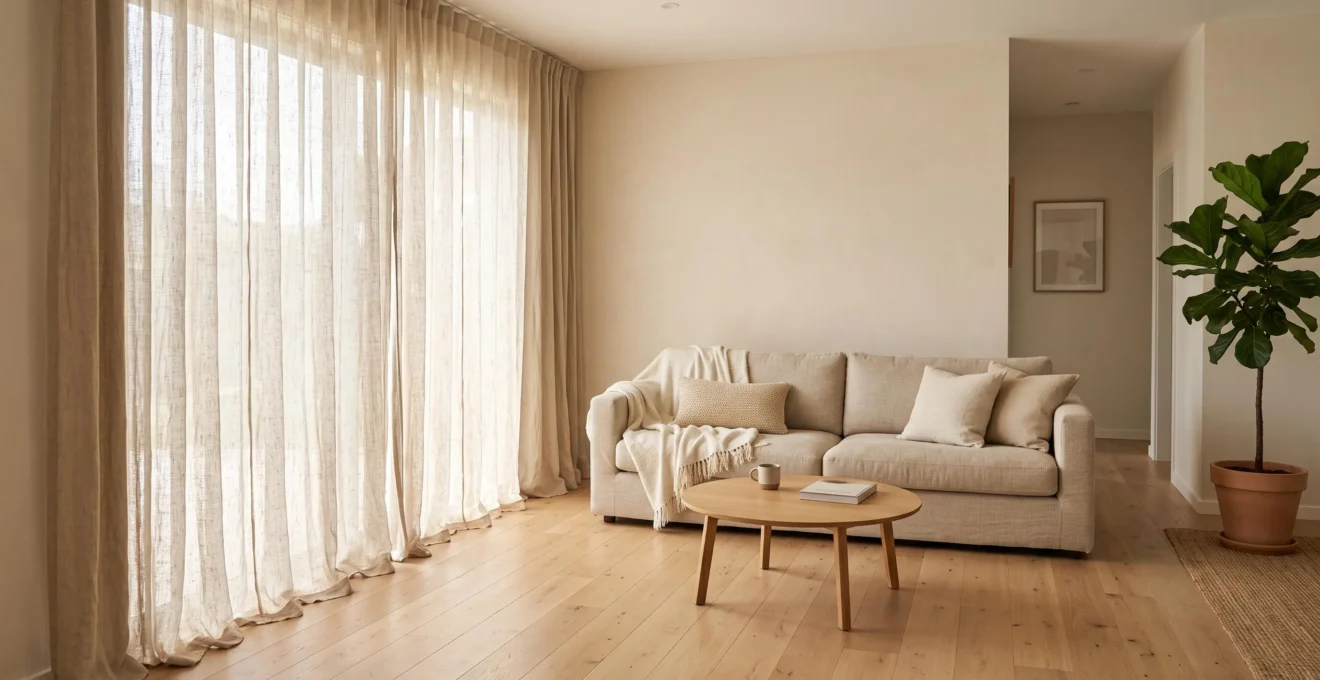
Linen draperies soften a room by filtering direct sunlight, introducing natural texture and framing windows without the visual heaviness of thick curtains. Choosing an appropriate weave and installing the panels beyond the window frame can preserve useful daylight while creating a calmer, more relaxed interior.
The important distinction is between softening light and reducing its quantity. A room can remain bright yet feel more comfortable when a fabric interrupts direct glare and distributes the incoming light more gently. However, linen is not completely transparent: even lightweight panels reduce some of the daylight reaching the room.
The right solution depends on the window’s orientation, nearby buildings, privacy requirements and how the space is used after sunset. A north-facing living room may benefit from lightweight linen that admits as much daylight as possible, while a sunny bedroom may need a denser fabric or a separate blind. Fabric samples, careful measurements and observations at different hours are more reliable than choosing by appearance alone.
Linen Draperies: The Essentials
- Choose the weave and fabric weight according to daylight, glare and privacy needs rather than assuming every linen curtain behaves alike.
- Mount rods beyond the window frame and allow sufficient panel fullness to create relaxed folds without unnecessarily covering the glass.
- Use separate blinds or shades when reliable nighttime privacy, substantial glare control or bedroom darkness is essential.
- Why Do Linen Draperies Create a Softer Light Than Heavy Curtains?
- How Should You Hang Linen Draperies So They Look Full but Relaxed?
- Sheer or Heavy Linen Draperies: Which Offer the Right Balance of Light and Privacy?
- What Makes Linen Draperies Look Untidy Rather Than Relaxed?
- When Should You Layer Linen Draperies With Blinds or Heavier Curtains?
- How Can You Adjust a Room’s Texture Between Warmer and Cooler Months?
- Warm or Cool Light: Which Works Better for Living Areas and Workspaces?
- How Can You Plan Interior Lighting for Both Practical Tasks and Evening Atmosphere?
Why Do Linen Draperies Create a Softer Light Than Heavy Curtains?
Linen draperies can create softer-looking daylight because their woven structure allows some sunlight to pass through while interrupting direct views of the brightest areas outside. Heavy, opaque curtains primarily reduce incoming light, whereas translucent linen can moderate glare without making the room feel closed off. The result depends on the fabric’s construction, not simply its fiber content.
Linen is made from flax fibers, and its characteristic irregular yarn thickness produces subtle variations in the woven surface. These variations contribute to the fabric’s textured appearance and can influence how light passes through it. However, the claim that hollow linen fibers uniquely scatter light more effectively than comparable polyester sheers is not established by the available product evidence. Weave density, yarn structure, color and finishing also matter.
Two different effects explain linen’s appeal. The first is light diffusion: a suitable translucent weave reduces the sharpness of direct sunlight and can make illuminated surfaces appear more evenly lit. The second is visual softness: linen’s natural slubs, matte surface and flowing folds soften the edges of a window and reduce the impression of rigid architectural lines.
For example, LinenMe’s lightweight linen curtain specifications describe a prewashed, 100% linen panel weighing 165 g/m². The manufacturer explains that this particular fabric allows natural light to filter through. That specification provides a useful product reference, but it does not establish a universal weight threshold or measured transmission rate.
Fabric weight, expressed in grams per square metre (g/m²), is a useful initial comparison when samples have similar construction. It should not be treated as a direct measurement of light transmission: a tightly woven fabric and an open-weave fabric of similar weight can behave differently.
For a north-facing room with limited direct sunshine, begin by examining lighter, more open fabrics. For a south-facing room affected by strong sunlight, compare medium-density weaves that offer greater screening. These are practical starting points, not fixed orientation-based rules.
A very thin sheer is not automatically the softest choice. If its weave remains sufficiently open to reveal a bright patch of sky or direct sunlight, uncomfortable glare may persist. A somewhat denser linen can sometimes produce a more comfortable visual result, although it may also reduce more daylight.
Always compare samples against the actual window during the brightest period of use. That is the clearest way to assess whether the chosen fabric delivers softness without sacrificing too much natural illumination.
How Should You Hang Linen Draperies So They Look Full but Relaxed?
Linen draperies look full but relaxed when their total fabric width creates generous, even folds and the rod allows opened panels to clear most of the glass. Positioning the hardware above and beyond the window frame, choosing an intentional hem length and arranging the folds after hanging produces a natural appearance without unnecessary bulk.
The amount of fabric is usually described by the fullness ratio: the combined flat width of all panels divided by the width they need to cover.
A ratio of 2:1, for example, means using a total flat fabric width twice the span being covered. For a hypothetical 200 cm curtain span, that means approximately 400 cm of combined panel width. The actual purchasing calculation should also account for the heading system, overlap and the manufacturer’s measuring instructions.
According to The Shade Store’s curtain measurement instructions, many draperies use approximately 1.5–2 times the covered width, while lightweight or sheer materials may benefit from 2.5–3 times the width for comparable fullness. These are professional guidelines rather than strict linen-specific requirements.
For lightweight linen, fuller gathering can produce attractive vertical movement. For thicker linen, excessive fullness may create dense bunching around the rod. The best ratio depends on how the fabric falls when gathered and how much space the opened panels occupy.
Rod placement is just as important as fabric width. Extending the rod beyond the window frame gives the curtains somewhere to gather when opened. The Shade Store describes extensions of approximately 6–12 inches (15–30 cm) on either side for outside-mounted curtains, although the appropriate distance depends on the panel stack and available wall space.
Length determines whether the result feels tailored or casual. A hem that just reaches the floor is restrained and easy to maintain. A small break at the floor introduces a relaxed finish, while deeper pooling creates a more decorative effect and requires greater attention to cleanliness and fold arrangement.
After installation, gently steam the fabric if permitted by its care label and distribute the folds evenly. Check that the hem falls consistently and that no section is trapped behind furniture.
Five Steps to a Balanced Linen Installation
- Measure the coverage span: Record the width the closed curtains must cover, including the intended overlap.
- Choose a fullness ratio: Calculate the combined flat panel width and write down the selected heading style.
- Mark the rod position: Identify mounting points and verify that the opened panels can clear as much glazing as practical.
- Set the hem length: Choose floor-touching, slight-break or pooling length and confirm consistent clearance.
- Check the finished installation: Photograph the curtains open and closed in morning and afternoon light, noting any glare or uneven folds.
Once the panels hang properly, assess how the fabric changes the visibility through the window. A beautifully gathered curtain still needs to meet the household’s privacy requirements.
Sheer or Heavy Linen Draperies: Which Offer the Right Balance of Light and Privacy?
Sheer linen is generally best for maximizing daylight where privacy demands are limited, while denser linen offers more visual screening at the cost of some brightness. Medium-weight washed linen can provide a practical compromise. However, even a fabric that feels private during the day may reveal silhouettes at night when indoor lighting becomes brighter than the exterior.
The right choice begins with the view through the window. A rear-facing upper-floor room with limited overlooking may need only gentle daylight filtering. A ground-floor living room facing a public pavement needs stronger screening, particularly after sunset.
The following comparison describes typical qualitative behavior, not measured light-transmission or privacy ratings. Actual performance varies with weave, color, thickness, lighting direction and distance from the fabric.
| Criterion | Sheer linen or voile | Medium-weight washed linen | Dense or heavy linen |
|---|---|---|---|
| Daylight | Generally admits more light | Filters more of the incoming light | May substantially reduce daylight |
| Daytime privacy | Limited and lighting-dependent | Usually provides stronger screening | Often provides greater screening |
| Nighttime privacy | Silhouettes may be visible | Requires testing | Depends on opacity and construction |
| Visual character | Airy, delicate folds | Relaxed, textured drape | More substantial, structured folds |
| Typical application | Low-exposure windows | Living rooms seeking balance | Rooms needing stronger screening |
Nighttime privacy is the critical limitation of sheer linen. During daylight, a bright exterior can make the darker interior difficult to see. After sunset, turning on indoor lamps reverses that brightness relationship. Occupants and furniture may become visible through an otherwise attractive sheer curtain.
That is why a fabric described as providing daytime privacy should not automatically be considered suitable for street-facing bedroom or bathroom windows.
A simple sample test helps reveal the difference. Hold the material against the actual window and observe it from the exterior or from the direction of the neighbouring property, where safely and practically possible. Repeat after dark with the lights on.
Look specifically for recognizable silhouettes, movement and identifiable details rather than relying on whether the fabric appears opaque in your hand. A sample viewed against a bright wall does not reproduce every real-world lighting condition.
For a north-facing upper-floor room, light linen voile may be sufficient. A street-facing living room may benefit from medium-density linen combined with a separate privacy shade. A bedroom requiring darkness may need an opaque lining or an independent blackout treatment.
Once privacy and daylight are balanced, consider how the panels will age visually. Natural texture is desirable, but inconsistent lengths and poorly arranged folds can quickly make the installation seem neglected.
What Makes Linen Draperies Look Untidy Rather Than Relaxed?
Linen draperies look untidy when their folds, hems or hanging positions appear accidental rather than deliberately arranged. Uneven pooling, random packing creases, insufficient fullness and poorly placed rods can undermine the fabric’s natural character. A relaxed look still depends on consistent proportions, a controlled fall and enough attention to installation and care.
The distinction between relaxed and messy is especially clear in three details: consistent hem length, even pooling and balanced stacking.
When one panel touches the floor while another hangs noticeably higher, the arrangement looks unfinished. Similarly, a generous puddle can appear intentional when distributed evenly, but a single twisted accumulation of fabric may look like a measuring mistake.
Linen naturally develops creases, particularly when washed or folded for storage. Vertical creases that follow the hanging direction often reinforce its casual appearance. Strong horizontal folds left by packaging may interrupt that visual flow and make the panel look poorly prepared.
Steaming after hanging, where permitted by the care label, can help reduce storage creases and encourage more consistent vertical folds. Some linen treatments are deliberately designed to retain a crumpled or washed appearance, so perfectly smooth fabric is not the goal.
Scale also matters. Panels that stop awkwardly above the floor may visually shorten the room unless a deliberate floating hem has been specified. A low-mounted rod can make the window feel compressed, while a narrow rod that leaves too little stacking space creates bulky folds against the glass.
Insufficient fullness is another common problem. When the curtains close almost flat, linen loses much of the dimensional texture that gives it a soft appearance. Conversely, excessive gathering in a heavy fabric may make the top of the window appear congested.
Maintenance should be considered before the first wash. Linen can change dimensions or drape after laundering, depending on whether the fabric was prewashed, how it was finished and how it is cared for.
The LinenMe product described earlier is prewashed, and its manufacturer advises washing at no more than 40°C and recommends steaming when ironing. These instructions apply to that particular product; other linen draperies may have different care requirements, including professional cleaning.
After washing, check the panel length before adjusting the hem permanently. Rehang the curtains, let the fabric settle and examine the folds before deciding whether any alteration is necessary.
When the appearance is under control, the next decision is functional: whether linen alone can manage privacy, brightness and comfort or whether the window needs another treatment.
When Should You Layer Linen Draperies With Blinds or Heavier Curtains?
Layer linen draperies with blinds or heavier curtains when the fabric alone cannot provide nighttime privacy, bedroom darkness or sufficient control of strong sunlight. The most effective arrangement assigns different jobs to each treatment: linen softens the window visually, while a separate blind or opaque layer delivers adjustable screening and light control.
Layering works best when it solves a specific problem rather than simply adding more fabric. Three situations commonly justify a second treatment:
- Street-facing or overlooked windows: A privacy blind can prevent visibility into the room after sunset.
- Bedrooms: An opaque roller blind or suitable blackout treatment can limit incoming light during sleep.
- Strongly sunlit rooms: An adjustable shade can reduce direct glare and help manage unwanted solar gain.
In many living rooms, a simple roller blind mounted close to the glazing is an effective companion to relaxed linen panels. The blind provides variable control while the draperies remain positioned to frame the window.
The functional distinction is important. As explained in the U.S. Department of Energy guidance on residential window performance, visible transmittance and solar heat gain represent different aspects of window performance. Proper use of interior blinds or shades can help control unwanted solar heat gain while retaining useful daylight.
That guidance concerns window systems and shading principles, not measured performance for individual linen curtain fabrics. It does not mean that every blind will produce the same thermal effect or that linen itself can provide equivalent heat control.
For a visually coherent result, pair textured linen with a restrained second treatment. A flat roller blind or neatly fitted Roman blind generally introduces less visual competition than several heavily gathered layers.
Plan both treatments’ stacking areas before installation. A fully raised blind may still occupy space near the top of the glazing, and open curtains can obscure the sides. Even when both treatments are retracted, poor placement may reduce the visible window area.
Where preserving daylight is the main objective, mount the linen hardware wide enough for the panels to stack away from the glass and choose a blind mechanism that minimizes unnecessary obstruction.
Once that functional arrangement is established, the same window treatment can also support seasonal changes without replacing the entire interior scheme.
How Can You Adjust a Room’s Texture Between Warmer and Cooler Months?
A room’s texture can change with the seasons by adjusting linen fabric weight, fold density, color and accompanying textiles. Lightweight, open-weave curtains create an airy impression during warmer months, while denser linen, deeper folds and soft furnishings introduce a more enveloping character in cooler weather. The main challenge is adding warmth without unnecessarily reducing scarce winter daylight.
In summer, a relaxed linen installation can feel visually light when the panels are held open and the weave remains visible against the window. Neutral shades, relatively sparse folds and breathable-looking textiles reinforce this effect.
Lightweight linen does not automatically guarantee better ventilation. Actual airflow depends on window opening, fabric permeability and whether the panels obstruct the opening. When natural ventilation matters, keep curtains clear of the opening and assess the room’s airflow directly.
In winter, denser fabric and fuller folds can make the room feel more enclosed and comfortable. This is partly a perceptual effect: textured materials and layered surfaces can suggest warmth even when the room’s actual air temperature remains unchanged.
It is important not to confuse that visual impression with measured thermal insulation. A particular curtain’s insulating performance depends on its construction and installation, and an ordinary linen panel should not be assumed to perform like a tested thermal window covering.
A seasonal textile adjustment need not involve replacing every curtain. For instance, a room with neutral linen panels can take on a warmer character through wool or textured cotton cushions, a heavier throw and warmer accent colors.
Alternatively, the same curtain rod and hardware may accommodate different panel weights, provided the system has adequate load capacity and the replacement headings are compatible.
Protect winter daylight. During shorter or overcast days, adding warmth by permanently covering more glass can make the room feel unnecessarily gloomy. Use richer texture, warmer textile tones or adjustable supplementary layers instead of automatically closing denser curtains throughout the day.
In sunnier periods, draw the linen across the window only when glare becomes uncomfortable. At other times, allowing the panels to stack outside the glazing keeps the room connected to the available daylight.
Seasonal color choices also affect how linen responds to lamps after sunset, making artificial lighting the next important element in a balanced room.
Warm or Cool Light: Which Works Better for Living Areas and Workspaces?
Warm lighting usually complements the relaxed atmosphere associated with linen draperies in living areas, while neutral or moderately cool lighting may suit workspaces that need a more alert, task-focused environment. However, neither color temperature is universally best. The appropriate choice depends on the activities, brightness needs, fabric undertones and surrounding finishes.
Light-source color temperature is expressed in kelvin (K). Lower correlated color temperatures generally appear warmer or more yellow, while higher values appear cooler or more bluish-white.
An Illuminating Engineering Society article on lighting controls describes approximately 2700–3500 K as a warm range commonly associated with residential and relaxing environments. It also identifies approximately 3500–4000 K as a cooler range frequently used in offices and commercial spaces.
These ranges provide context rather than fixed design requirements. Lighting comfort also depends on illuminance, distribution, glare, visual tasks and individual preferences.
For a living room with natural ecru linen, warm bulbs may emphasize the fabric’s beige or yellow undertones and reinforce a welcoming atmosphere. A neutral white or bleached linen may respond differently, particularly when surrounded by cool-colored walls and furniture.
Lighting at 4000 K or above does not inherently flatten linen texture or make the fabric gray. The perceived effect depends on the light’s direction, intensity, spectrum and the fabric’s actual color.
In a workspace, accurate visual tasks may justify more carefully controlled brightness and color rendering. However, color temperature alone does not determine how accurately colors appear. A higher correlated color temperature should not be treated as a substitute for evaluating the light source’s color-rendering properties.
A practical approach is to select the room’s main lighting according to its primary use, then test a linen sample under the intended bulbs. Observe the fabric next to painted walls, wood surfaces and furniture rather than judging it in isolation.
For combined living-working rooms, adjustable task lighting can provide additional brightness at the desk while the general lighting remains warmer and softer elsewhere.
Avoid introducing numerous conflicting light colors without a reason. Mixed temperatures are not inherently wrong, but strongly contrasting sources can make the same linen panel appear different across the room. A consistent ambient setting, complemented by task-specific lighting, is usually easier to control.
The final stage is to coordinate daylight, task lighting and evening atmosphere so the room remains comfortable as natural illumination changes.
Key Takeaways Before Planning Your Lighting
- Treat the linen-covered window as part of the daytime lighting strategy, not as a substitute for adjustable electric lighting.
- Use independently controlled light sources so a bright task area does not dictate the atmosphere of the entire room.
- Evaluate the room during bright daylight, overcast conditions and after dark before finalizing fixture positions and brightness settings.
How Can You Plan Interior Lighting for Both Practical Tasks and Evening Atmosphere?
Plan interior lighting around three complementary layers: ambient illumination for general visibility, task lighting for activities and accent lighting for atmosphere or architectural detail. Linen draperies help shape daytime ambient light, but evening comfort depends on appropriately positioned artificial sources. Adjustable lighting allows the room to move from daylight to evening use without becoming harsh or uneven.
The relationship between window treatments and lighting is easier to understand when the different layers have distinct functions.
| Lighting layer | Primary function | Practical example |
|---|---|---|
| Ambient | Provide comfortable overall visibility | Diffused ceiling lighting, indirect fixtures or floor lamps |
| Task | Illuminate specific activities | Adjustable desk lamp or focused reading light |
| Accent | Create depth and emphasize selected features | Wall lighting, shelving illumination or a restrained decorative lamp |
During the day, linen-covered windows contribute filtered daylight to the ambient layer. A well-chosen fabric can make direct sunlight less visually dominant, but it can also leave some corners darker than they would be with an uncovered window.
Rather than increasing general artificial brightness everywhere, place supplementary light where it is actually needed. A reading chair or desk may benefit from a dedicated fixture even while the rest of the room receives adequate daylight.
At dusk, replace the soft character of filtered daylight gradually with diffused or indirect electric light. A single exposed, very bright ceiling fixture may create sharper contrasts than the daytime setting. Multiple lower-brightness sources can offer greater flexibility, especially when independently controlled.
In rooms combining work and relaxation, keep desk lighting directed toward the work surface rather than toward the window. A bright fixture aimed at translucent curtains may illuminate the fabric from inside and make interior silhouettes more apparent from outside at night.
For evening privacy, close the more opaque blind or supplementary treatment before switching on brighter lights if visibility from outside is a concern.
Check the completed room at three different moments:
- Bright midday: Identify direct glare, overly bright patches and whether the linen sufficiently filters sunlight.
- Overcast afternoon: Look for dim task areas and corners that may benefit from supplementary lighting.
- Evening: Test fixture brightness, fabric appearance and privacy from outside when indoor lamps are on.
Make one adjustment at a time: change a blind position, redirect a task lamp or dim an ambient fixture, then reassess. This helps identify the specific improvement rather than compensating for one problem with unnecessary additional lighting.
Where dimming or daylight-responsive controls are available, use them to adapt electric lighting as natural light changes. The goal is comfortable, usable illumination, not a constant brightness level regardless of the room’s activities.
Start with the most frequently used room: evaluate a linen sample against its main window, confirm the privacy requirement, then adjust one ambient fixture and one task light. Those small tests will reveal whether the fabric, installation and lighting work together before committing to the complete window treatment.
Are white linen draperies always better for keeping a room bright?
Not necessarily. White or pale linen often creates a visually bright appearance, but actual daylight transmission also depends on weave openness, thickness and finishing. A tightly woven white curtain can admit less light than a more open natural-colored fabric. Compare samples under the same lighting conditions before choosing.
Can linen draperies protect furniture from sunlight damage?
Linen curtains may reduce some direct light exposure, but their ability to protect furniture from ultraviolet radiation or fading cannot be established from appearance alone. Protection depends on the fabric and glazing characteristics. Where sunlight damage is a significant concern, consider window treatments with documented protective performance.
Should linen curtains be lined if maintaining daylight is the priority?
Unlined linen is generally the first option to examine when light filtering is the priority. Adding a lining changes the fabric’s opacity and may reduce incoming daylight considerably. If reliable privacy or darkness is only needed occasionally, a separately adjustable blind can provide greater flexibility than permanently lining the linen panels.
Is natural or undyed linen suitable for very sunny windows?
Natural or undyed linen may be worth considering for sunny exposures. LinenMe identifies natural shades as particularly lightfast within its product care guidance and warns that prolonged direct sunlight can fade dyed linen. However, durability and fading resistance vary by product, dye and finish, so check the manufacturer’s specifications before purchasing.
Can linen draperies work with inward-opening or tilt-and-turn windows?
Yes, provided the curtain hardware and stacking arrangement leave enough clearance for the window to operate. Check the full opening arc, handle position and ventilation mode before fitting rods or blinds. Where clearance is restricted, a wall-mounted linen curtain combined with a compact window-mounted shade may be easier to use.