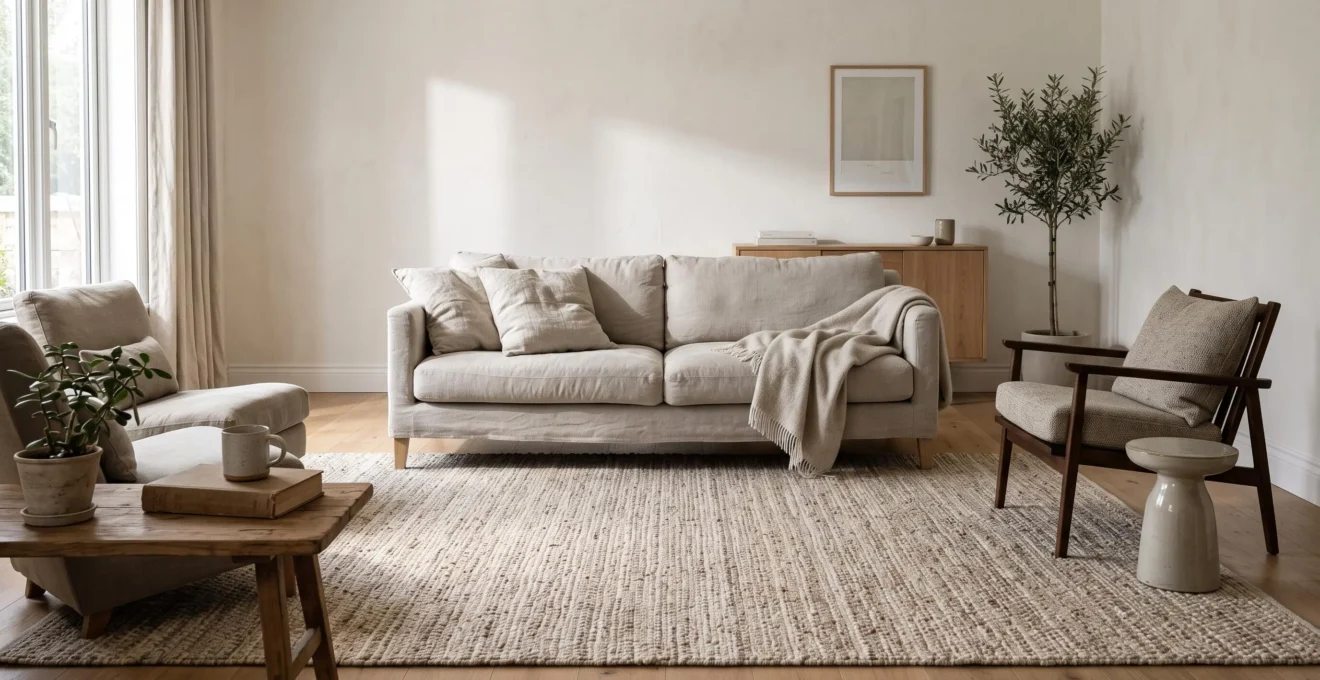
A woven rug can make a room feel warmer and more complete without introducing another bold colour, decorative object or competing pattern. Its strength lies in the way the weave catches light, changes the feel of the floor and visually connects furniture that might otherwise appear scattered.
This is particularly useful in homes with timber, tile or stone flooring. These hard surfaces offer a clean foundation, but large expanses of smooth material can leave seating areas feeling exposed. A carefully chosen rug introduces a softer surface while preserving the simplicity of the surrounding space.
The key is to treat texture as a design element that needs proportion, contrast and breathing room. Rug size, weave density, furniture placement and everyday movement all influence whether the result feels balanced or cluttered. A restrained flatweave may be ideal for a busy dining area, while a thicker woven construction can bring comfort to a quieter living space.
Woven Rugs: The Essentials for a Balanced Room
- Choose a low-contrast weave to introduce depth through texture rather than additional colour.
- Size and position the rug around furniture and daily activities, keeping walking routes clear.
- Match the rug’s construction to foot traffic, cleaning needs and the amount of softness the room requires.
- Why Can a Woven Rug Make a Neutral Room Feel More Complete?
- How Should You Position a Woven Rug Under Living-Room Furniture?
- Flatweave or Thick Woven Rug: Which Works Better in a Busy Home?
- Which Woven Rug Mistakes Make a Room Look Smaller or Less Safe?
- When Should You Rotate a Woven Rug to Prevent Uneven Fading and Wear?
- How Can You Add Tactile Materials Without Covering Every Surface?
- How Can You Divide One Room Into Seating, Dining and Working Zones?
- How Can You Plan a Room Layout Around Real Daily Activities Instead of Appearance Alone?
Why Can a Woven Rug Make a Neutral Room Feel More Complete?
A woven rug makes a neutral room feel more complete by introducing variation into an otherwise uniform collection of surfaces. Its interlaced fibres create small differences in height, shadow and touch, adding depth without requiring contrasting colours. The result is a more layered interior that can still feel visually quiet.
Consider a room with pale walls, a smooth linen sofa, a light oak floor and simple timber furniture. Although the colours coordinate, nearly every surface may have a similarly smooth appearance. The room can feel unfinished because it lacks material contrast, not because it needs more decoration.
A rug with a subtle bouclé-like looped surface, a flatwoven structure or a restrained high-low weave changes this relationship. Raised yarns catch side lighting, recessed areas form gentle shadows, and the floor gains visual variation even when the rug closely matches the surrounding palette.
It helps to distinguish visual texture from tactile texture. Visual texture is what the eye interprets through weave, shadow and surface irregularity. Tactile texture is the physical sensation experienced through contact. A woven rug can contribute both: it provides an additional layer of visual interest while changing how the floor feels under bare feet.
Wall art can add visual contrast, and cushions can make seating more comfortable. Neither, however, changes the large floor surface that connects the furniture. That is why a rug often has a particularly noticeable effect in an otherwise simple interior.
A useful diagnostic test is to look at the room from its entrance. If the floor forms one broad, uninterrupted surface beneath several separate pieces of furniture, the room may benefit from a rug before it needs more accessories.
For a neutral setting, try a cream-and-oatmeal weave, a soft tonal herringbone or a natural-looking woven surface with restrained variations in yarn thickness. These choices create material contrast without introducing a strong new colour relationship.
A colourful patterned rug can also work, but its contrast will usually attract more immediate attention. Low-contrast texture is especially effective when the goal is quiet richness rather than a decorative focal point.
Once the room has enough material variation, placement becomes the next priority: even a beautifully textured rug can feel disconnected if it does not relate clearly to the furniture.
How Should You Position a Woven Rug Under Living-Room Furniture?
Position a woven rug so it visually connects the main seating pieces rather than appearing as an isolated rectangle on the floor. Placing at least the front legs of the sofa and principal chairs on the rug is a useful starting point. Larger rooms may accommodate all furniture legs, provided walkways remain comfortable.
The most reliable placement method begins with the furniture grouping. Stand where people normally enter the room and identify which sofa, chairs and tables belong to the same conversation area. The rug should establish a shared foundation for that group rather than merely fill an empty space.
There are three common arrangements, each with a different effect:
- Front legs on: the front legs of the main seating pieces rest on the rug, visually connecting the group without requiring an unusually large floor covering.
- All legs on: the entire seating arrangement sits within the rug’s boundaries, producing a contained, clearly defined zone.
- All legs off: a smaller rug sits independently, often beneath a coffee table. This can work as a deliberate decorative choice, but it offers less connection between the larger furniture pieces.
The first two arrangements are generally easier to use when the purpose is to anchor a complete seating area. Homes & Gardens‘ living-room rug placement recommendations similarly describe placing furniture on the rug, or at least using the front legs when fitting the entire grouping is impractical.
The rug’s perimeter also influences how the seating area is perceived. When its edges extend beyond the furniture’s front contact points, the grouping can read as a coherent arrangement. If the rug ends abruptly before reaching an adjacent armchair, that chair may appear visually separate.
Measure the furniture footprint before choosing a rug. Mark the proposed perimeter on the floor with removable painter’s tape suitable for the flooring finish. Check whether each principal seat overlaps the intended rug area and whether the proposed boundary leaves space for people to move around the furniture.
There is no universal distance that the rug must extend beyond every furniture leg. The relevant test is whether the rug feels comfortably proportioned to the furniture, without an awkward narrow strip or an unexpected edge beneath a common walking route.
On smooth timber, stone or tile, stability matters as much as appearance. Flatwoven rugs can shift or wrinkle depending on their weight, construction and backing. Select a floor-compatible, non-slip rug pad that suits the rug, and confirm that it does not create raised edges or damage the floor finish.
Once the furniture is visually connected and the rug sits securely, its construction should reflect how the household uses the space each day.
Flatweave or Thick Woven Rug: Which Works Better in a Busy Home?
Flatweave rugs generally suit active rooms where chairs move frequently, low clearance matters and an understated surface is desirable. Thicker woven rugs offer greater cushioning and a stronger sense of softness, making them appealing in quieter seating areas. Neither is universally better: the practical choice depends on traffic, fibre, construction and maintenance requirements.
A flatweave is typically made with a relatively low-profile woven structure rather than a deep pile. It can introduce fine geometric detail or subtle yarn variation while remaining visually light. A thick woven rug has more depth or bulk, which can make a room feel softer but may require additional care around furniture and circulation.
Compare the two constructions against the conditions that matter in everyday use.
| Consideration | Flatweave rug | Thick woven rug |
|---|---|---|
| Cleaning | Low-profile surfaces can be convenient to vacuum; washing depends on the care label. | Deeper or denser textures may require more attention to embedded dirt. |
| Moving chairs | Usually presents less pile resistance, although lightweight rugs may shift. | Chair legs may drag or sink into softer constructions. |
| Door clearance | Low height is often useful beneath nearby doors. | Extra thickness may interfere with door movement. |
| Visual effect | Adds definition and pattern with relatively little bulk. | Creates a more substantial textured focal surface. |
| Underfoot comfort | Generally firmer, with comfort influenced by the rug pad. | Often softer and more cushioned. |
| Acoustic comfort | Introduces a textile surface that may soften the room’s acoustic character. | Greater thickness may provide additional sound absorption, depending on construction. |
In a dining space where chairs are pulled back repeatedly, a firm, low-profile rug usually interferes less with the movement. In a living room where people sit on the sofa, read or occasionally lounge on the floor, a thicker woven surface may provide more useful comfort.
Pets and spills add another consideration. A flatweave may be easier to shake out or vacuum, but flatweave does not automatically mean machine-washable. Reversibility, stain treatment and washing suitability depend on the specific product.
For cleaning decisions, the Carpet and Rug Institute‘s cleaning and maintenance guidance recommends routine vacuuming, prompt attention to spills and cleaning methods appropriate to the rug’s construction and instructions.
A useful alternative is layering: place a larger flatweave beneath the main furniture grouping, then add a smaller thick woven rug in a selected seating spot. The base provides visual continuity while the upper layer introduces concentrated softness.
Layering does require care. Both rugs must remain stable, the additional height must not obstruct movement, and exposed edges should not create catching or tripping points. The base rug should only be described as washable if its own care label permits washing.
The most practical decision is therefore not simply flat versus thick. Identify the room’s dominant activity first, then choose the rug construction that supports it without creating additional maintenance or movement problems.
A well-matched construction makes a rug easier to live with, but correct material choice cannot compensate for poor sizing, unsecured edges or an inconvenient position.
Which Woven Rug Mistakes Make a Room Look Smaller or Less Safe?
The most common woven rug mistakes are choosing a rug too small for its furniture grouping, allowing edges to curl or slide, combining too many competing textures and placing the rug across essential walking routes. These choices can fragment the room visually or introduce avoidable hazards, particularly on smooth hard flooring.
An undersized rug is often the first issue to address. When a sofa, two chairs and a coffee table surround a tiny rug without meaningfully overlapping it, the floor may appear divided into disconnected patches. A better-proportioned rug establishes one clear seating area and can make the arrangement feel more expansive.
The opposite problem is a rug whose boundaries extend awkwardly into unrelated spaces. Oversized rugs can obscure useful floor transitions or overlap furniture belonging to another activity zone. The ideal size responds to the furniture footprint rather than the room’s overall dimensions alone.
Security is equally important. A lightweight flatweave may slide across polished flooring, while a poorly matched pad can contribute to wrinkling or raised edges. A curled corner can catch a foot, and a moving rug can become particularly troublesome where people turn, carry objects or use mobility aids.
Guy’s and St Thomas’ NHS home fall-prevention guidance identifies loose rugs as potential hazards and recommends removing them or securing them, alongside keeping walking routes clear.
For everyday interiors, this means checking the following points:
- All corners lie flat and remain flat after people walk across them.
- The rug and any pad stay in position during normal movement.
- Doors open freely without scraping, lifting or catching the rug.
- Edges do not create awkward steps along frequently used paths.
- The rug does not conceal or complicate a floor-level transition.
Visual clutter is a different but related mistake. A highly patterned rug beneath patterned cushions and strongly patterned curtains can create multiple competing focal points. The same difficulty may arise when a pronounced chunky weave sits over a visually active timber floor with strong grain and colour variation.
The solution is not to eliminate texture. Instead, control its intensity. Let one surface carry the stronger pattern while other large surfaces remain relatively plain. On a busy wood floor, a soft, close-toned weave can provide separation without adding another dominant motif.
Five Checks Before Finalising Your Woven Rug
- Mark the proposed rug outline on the floor and take a photograph showing how it relates to every main furniture piece.
- Open and close nearby doors fully, recording any position where the proposed rug thickness would cause interference.
- Walk the normal routes through the room and note whether the rug boundary crosses a frequent turning or stepping point.
- Compare the rug sample against the floor, sofa and curtains in daylight, then record which surface carries the strongest pattern.
- Confirm the selected rug-pad compatibility and check that the installed rug remains flat, secure and free from shifting edges.
After the rug is correctly sized and secured, ongoing care becomes the next way to preserve its appearance and usefulness.
When Should You Rotate a Woven Rug to Prevent Uneven Fading and Wear?
Inspect a woven rug every few months and consider rotating it when one area shows noticeably more traffic wear or sunlight exposure than another. The appropriate interval depends on how the room is used, the rug’s construction and the direction of natural light. Visible differences are a better guide than an inflexible calendar rule.
Two processes are worth distinguishing. Foot traffic repeatedly presses and rubs fibres along predictable routes, potentially causing flattening and accumulated soiling. Sunlight can gradually affect exposed dyes, particularly when one section receives more direct light than the rest.
These changes may occur in different parts of the same rug. A pathway between a doorway and sofa may receive the most walking traffic, while an area beside a window receives the strongest sunlight.
Rotating a rectangular rug by half a turn may redistribute future exposure, provided its shape, dimensions, pattern and furniture arrangement allow it. However, rotation cannot restore colour that has already faded or reverse permanent fibre damage.
Use a simple inspection routine:
- Compare the rug’s exposed sections with areas that spend more time beneath furniture.
- Look for visible flattening, uneven soiling or changes in the weave’s appearance along common routes.
- Check whether the window-facing area looks different in colour from the shaded section.
- Consider whether rotating the rug will actually redistribute the dominant exposure.
- Inspect the backing, edges and any rug pad before putting everything back into place.
Some rugs are easier to rotate than others. An all-over, non-directional weave is often flexible, while a directional motif may appear visually incorrect after turning. Rugs with asymmetrical fringe or shapes designed around particular furniture arrangements may also resist straightforward rotation.
Where rotation is impractical, other measures may be more effective. Window treatments can reduce prolonged direct sunlight, while small changes to furniture position may help vary concentrated traffic where the layout permits it.
Regular maintenance remains essential. Vacuum according to fibre and manufacturer guidance, giving additional attention to walked-on areas. Deal with spills promptly using an appropriate cleaning method, and avoid aggressive vacuum attachments on delicate fringes.
Some flatweaves can be used on either side, but this must be confirmed for the individual rug. A backing, decorative finish or different reverse construction may prevent safe or attractive flipping.
Maintaining the rug’s surface helps preserve its role in the room, but long-term visual balance also depends on how much texture surrounds it.
How Can You Add Tactile Materials Without Covering Every Surface?
Add tactile materials selectively by distributing them across a few different surfaces rather than repeating texture everywhere. A woven rug on the floor, a soft throw on the sofa and one tactile decorative object can provide sufficient material contrast. Keep other large surfaces calm so each textured element has room to be noticed.
Think of the room in terms of sensory planes. The floor is the grounding plane, seating provides regular physical contact, and smaller objects offer occasional touch points. Each plane can contribute something different without needing elaborate decoration.
For example, a low-contrast chunky woven rug may work alongside a smooth linen sofa and a single textured ceramic vessel. The rug introduces substantial texture, the linen offers a quieter visual surface, and the ceramic provides a smaller material accent.
This arrangement relies on negative space. In interior styling, negative space is not necessarily empty floor area or a bare room. It is the presence of visually restful surfaces between more expressive elements.
If the rug, cushions, curtains, walls and upholstery all have strong irregular patterns, the eye has fewer quiet areas in which to settle. Even when every individual material is attractive, the combined composition may feel visually demanding.
A practical approach is to select two or three surfaces to carry noticeable texture. Keep at least one major element, such as a sofa or wall, relatively plain. Allow the woven rug to contribute much of the texture on the floor rather than competing with elaborate finishes throughout the space.
Material variety matters more than material quantity. A firm woven rug beside polished timber provides a clearer contrast than several closely similar knobbly fabrics layered together. Rough ceramics against smooth wood or chunky wool beside tightly woven linen can create distinct, complementary tactile experiences.
Colour is another useful control. Different textures in related neutral shades can remain visually coherent because the materials share a common palette. Conversely, a combination of strongly contrasting hues may feel busier even if the fabrics themselves are relatively smooth.
When choosing accessories, consider removing one item before adding another. If the rug already introduces a prominent geometric weave, smooth cushions may provide a better balance than cushions repeating the same motif.
This restraint becomes particularly important in open-plan interiors, where textures need to distinguish activities while still making the larger room feel connected.
How Can You Divide One Room Into Seating, Dining and Working Zones?
Woven rugs can distinguish seating, dining and working areas by giving each activity a recognisable footprint on the floor. Size the rug to the furniture used in that zone, maintain clear circulation between areas and repeat selected colours or weave characteristics. The aim is to create legible boundaries without making the room appear divided into unrelated islands.
In an open-plan room, one large continuous floor surface may serve several activities. Without physical partitions, the relationship between a sofa, dining table and desk can become unclear. Rugs provide boundaries that are visible without blocking sightlines.
In the seating zone, choose a rug that connects the sofa and principal chairs. The coffee table can sit within that grouping, helping the area read as a place for conversation and relaxation.
For the dining area, the rug must accommodate the movement of chairs. Check its dimensions with chairs pulled back as they would be during a meal, rather than judging the arrangement only when the chairs are tucked beneath the table. If chairs repeatedly catch the edge or drag across a deep pile, a low-profile rug—or no rug—may be more practical.
A working zone benefits from a different assessment. If a wheeled office chair moves frequently, a woven rug may introduce resistance or wear. In that situation, a suitable firm surface or leaving the work area uncovered can be more functional than forcing a rug into every zone.
Where multiple rugs are appropriate, repeat at least one visual characteristic. They might share a beige-and-stone palette, similar woven structures or aligned rectangular edges. Exact matching is unnecessary; a consistent material language can make the zones feel intentionally related.
Avoid allowing one rug to drift beneath furniture belonging to another activity. This can weaken the very boundary it is meant to establish. A visible stretch of uncovered floor between separate rugs is often helpful, particularly where people naturally walk between the zones.
Before committing to the layout, walk the routes between the kitchen, dining table, sofa and desk. Carry an object as you normally would and observe whether any proposed rug edge interrupts your steps or requires an awkward turn.
The important distinction is that each rug serves an activity, not simply an available patch of floor. In some rooms, two well-positioned rugs create a clearer arrangement than three smaller rugs, especially when the working area functions better on an uncovered floor.
Effective zoning creates the framework for a room, but the final layout should be tested against how its occupants actually live rather than how it looks in a photograph.
Key Takeaways Before Planning Your Layout
- Prioritise the activities that happen most often before deciding which areas need rugs.
- Measure furniture movement and walking routes, not only the space occupied when everything is neatly arranged.
- Choose rug proportions and textures that work with ordinary daily use, even when that means leaving an area uncovered.
How Can You Plan a Room Layout Around Real Daily Activities Instead of Appearance Alone?
Plan a room around its real activities by observing where people sit, eat, work, move and store everyday objects before deciding on furniture positions or rug dimensions. Use these patterns to define functional zones, then choose rugs that support them. A successful layout should remain comfortable when the room is being used, not just when it is perfectly arranged.
Start with an activity audit. Over a typical week, note which parts of the room are used most frequently. Record where people sit in the evening, whether the dining table doubles as a workspace, where children play, and which routes connect doors, seating and storage.
This exercise can reveal a mismatch between the intended layout and the actual one. A formal pair of armchairs might rarely be used, while one corner of the sofa becomes the household’s main gathering place. A desk placed for visual symmetry may receive poor task lighting or force people to cross the seating zone repeatedly.
Translate these observations into spatial requirements. A conversation area needs seating positioned for comfortable interaction. A dining arrangement needs space for chairs to move. A working area needs practical access to light, power and frequently used equipment.
Each activity can then guide rug selection. The seating area may benefit from a comfortably sized, thicker woven rug. Dining chairs may require a firmer, lower-profile surface. A workspace with a rolling chair may work better without a textile floor covering beneath its movement area.
Rather than buying a decorative rug first and trying to arrange furniture around it, define the dominant activity and its furniture footprint. Then select the rug’s dimensions, weave and position.
A useful practical test is to observe the proposed layout after ordinary use. Are chairs repeatedly shifted away from the rug? Do people walk across a loose corner? Does the dining table need additional clearance when guests visit? These behaviours can reveal constraints that a static floor plan misses.
Small adjustments may resolve the problem more effectively than purchasing another object. Moving a chair, changing the rug’s orientation or selecting a flatter weave can improve how the space functions while retaining the intended visual warmth.
The finished result should connect three priorities: comfort, clear movement and controlled visual texture. When those conditions work together, the woven rug supports both the room’s appearance and its daily purpose.
Choose one frequently used area to assess first. Observe its movement patterns, measure the necessary furniture footprint and compare rug samples against the existing flooring. These practical checks make it easier to add texture where it improves the room, without introducing clutter or unnecessary obstacles.
Can a woven rug work on an already patterned wooden floor?
Yes. Choose a restrained weave in a colour close to one of the timber’s existing tones. A rug with subtle yarn variation can soften a strongly grained floor without introducing another dominant pattern. Check the combination in natural light before selecting the final size.
Are natural-fibre woven rugs always better than synthetic ones?
No. Natural and synthetic fibres offer different textures, cleaning requirements and performance characteristics. Durability and comfort depend on the individual fibre, weave density, construction and finish. Consider the rug’s care instructions and intended use rather than assuming one material category is universally superior.
Should a woven rug match the sofa or the flooring?
It does not need to match either exactly. A useful approach is to choose a colour that relates to both surfaces while allowing the weave to provide the contrast. For example, an oatmeal-toned rug can connect a pale sofa with a warm timber floor without making every element the same shade.
Can you place a woven rug directly on tile or stone?
A woven rug can be used over tile or stone if it remains stable and does not obstruct doors or walking routes. Select a non-slip solution compatible with the floor finish and rug construction, and check the surface beneath periodically for moisture or other issues. Loose or curling edges should be corrected rather than ignored.
Is it better to use one large rug or several smaller rugs in an open-plan home?
Use one large rug when it can clearly anchor a single main activity area. Separate rugs are useful when different activities occupy distinct furniture groupings. There is no need to cover every zone: maintaining uncovered walking space can improve circulation and make the overall arrangement feel less crowded.