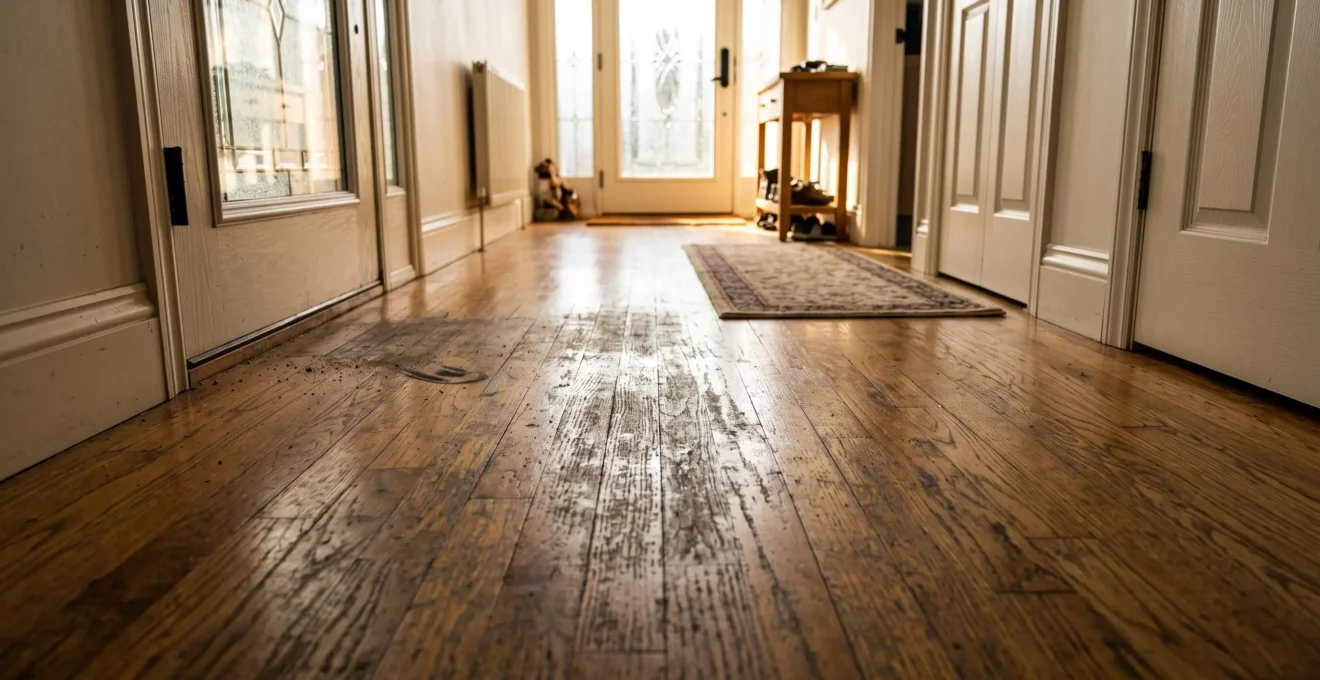
The most durable floor finish is not necessarily the hardest, glossiest or most expensive coating. In high-traffic rooms, lasting protection depends on matching the finish to the way the floor is used: abrasive grit in entrance halls, repeated foot movement in kitchens, occasional water exposure and the cleaning routine a household can realistically maintain.
For timber flooring, a suitable polyurethane-type lacquer can provide a protective, wipe-clean surface that works well in demanding residential spaces. Penetrating oils offer a different advantage: they can allow more localised maintenance, although they generally require closer attention. Matt and satin finishes also differ in how they reveal wear, but appearance should not be confused with measured durability.
Choosing well means identifying the room’s most demanding areas before comparing products. Door thresholds, sink fronts and frequently used routes often deteriorate sooner than the rest of a floor. The finish should protect these vulnerable locations without making everyday maintenance impractical.
Durable floor finishes: the essentials
- Choose a finish according to traffic, moisture exposure and maintenance requirements, not sheen alone.
- Film-forming lacquers offer a protective surface barrier; penetrating oils allow different maintenance approaches but generally need more frequent care.
- Renew worn finishes before bare wood is exposed, particularly at entrances, kitchen work zones and thresholds.
- Why Do Certain Floor Finishes Reveal Scratches More Quickly?
- How Can You Choose a Floor Finish for a Busy Hallway or Kitchen?
- Matt or Satin Floor Finish: Which Hides Everyday Wear Better?
- Which Floor Finishes Can Cause Problems in Wet or Busy Spaces?
- When Should a Floor Finish Be Renewed Before the Surface Is Damaged?
- Which Flooring Choices Can Fail Quickly in Wet or Gritty Areas?
- When Can Continuous Flooring Become Impractical Between Different Rooms?
- How Can Continuous Flooring Make Connected Rooms Feel Larger and More Cohesive?
Why Do Certain Floor Finishes Reveal Scratches More Quickly?
Some floor finishes reveal scratches more readily because their sheen and surface texture make small changes in light reflection easier to detect. High-gloss surfaces can highlight fine abrasion under angled lighting, while matt finishes often disguise scattered marks. However, a finish that hides scratches is not necessarily more scratch-resistant or better at protecting the underlying wood.
A scratch changes how light reflects from a floor. On a smooth, reflective finish, even a narrow line can interrupt an otherwise consistent reflection. This becomes especially obvious when sunlight enters through a doorway or when ceiling lights illuminate the boards at a shallow angle.
Lower-sheen finishes diffuse reflections, making some shallow marks less noticeable. Yet this visual advantage has limits: deep gouges, compressed wood fibres and dirt trapped in surface texture can remain conspicuous regardless of sheen.
Scratch visibility and physical scratch resistance are different performance characteristics. In its professional technical FAQ on floor finishes, Bona distinguishes abrasion resistance from scratch and scuff resistance. The manufacturer reports that matt and gloss formulations can exhibit similar measured wear resistance, while some gloss variants perform better in scratch and scuff testing. These observations concern its product systems and should not be treated as universal comparisons.
The depth of the damage also matters. A superficial scratch may affect only the protective finish, potentially allowing renewal without stripping the entire floor. A deeper mark that reaches the timber requires a different assessment because another coat cannot restore missing or damaged wood.
Wear rarely develops evenly. Hallway turning points, doorways and the floor immediately in front of a kitchen sink experience concentrated movement. Repeated pivoting can create visible micro-scratching while nearby boards retain their original appearance.
Consequently, a finish that looks excellent across an undisturbed sample may behave differently in a narrow circulation route. Evaluate its appearance under realistic lighting, but also examine technical information on abrasion resistance, appropriate use and future recoating.
Once scratch visibility is understood, the more important decision is selecting a protective system suited to the room’s heaviest use rather than its average conditions.
How Can You Choose a Floor Finish for a Busy Hallway or Kitchen?
Choose a floor finish for a busy hallway or kitchen by assessing three factors together: traffic intensity, moisture exposure and willingness to maintain the surface. A durable lacquer is often practical where frequent cleaning is essential, while an appropriate penetrating oil may suit households prepared for periodic local maintenance. Entrance grit and concentrated kitchen spills should determine the final choice.
Start by observing where people walk, stop and turn. A hallway with frequent outdoor traffic faces abrasive particles carried beneath shoes. A kitchen may receive less grit but experiences repeated movement around sinks, cooking areas and appliances, alongside occasional spills.
The highest-risk zone should establish the minimum performance requirement. Choosing a finish based on an otherwise quiet room can leave the doorway or sink area underprotected.
The following decision grid provides a practical starting point. It describes typical suitability rather than guaranteed performance; individual formulations and flooring manufacturers’ instructions remain decisive.
| Room conditions | Finish to consider | Main trade-off |
|---|---|---|
| Heavy foot traffic, limited moisture, minimal maintenance time | Durable polyurethane-type floor lacquer rated for demanding residential use | Protective surface film, but worn traffic lanes can eventually require recoating. |
| Frequent movement, occasional spills, willingness to maintain locally | Compatible penetrating oil system | Potential for targeted upkeep, with greater routine maintenance requirements. |
| Kitchen with frequent cleaning and promptly removed spills | Moisture-tolerant lacquer approved for the timber and intended cleaning regime | Good surface cleanability does not make joints or the underlying timber waterproof. |
| Entrance with substantial grit and repeated pivoting | Abrasion-resistant finish supported by effective dirt control | Even a robust coating will deteriorate if abrasive particles remain on the floor. |
| Low-maintenance household with frequent wet exposure | Assess whether timber is appropriate before selecting a finish | No surface treatment compensates for flooring unsuitable for persistent moisture. |
Film-forming lacquers create a protective layer over the timber. They can be convenient to clean, but concentrated wear may eventually produce a visibly degraded path. Penetrating oils work differently, treating the timber rather than relying on the same type of continuous lacquer film. Suitable oil systems can permit local maintenance, but wear affects the treated wood surface itself.
These categories are not interchangeable: hard-wax oils may form a surface film, and performance varies between formulations. Product approval, substrate compatibility and the manufacturer’s maintenance system matter more than a broad label such as “oil” or “polyurethane”.
For hallways, grit control is essential. Hard particles trapped beneath shoes or furniture feet repeatedly abrade the finish. A strong coating can slow deterioration, but entrance mats and regular grit removal address the cause more directly.
Kitchens introduce a different challenge: cleaning must remove food residues and moisture without leaving the floor repeatedly wet. The National Wood Flooring Association advises against wet and steam mopping on wood floors, making cleaning compatibility an important selection criterion.
Five checks before selecting a floor finish
- Map circulation. Mark entrances, turning points and frequently used walking routes on a simple room sketch.
- Identify water exposure. Note sinks, appliances, doors and recurring spill locations on the same sketch.
- Locate abrasive grit. Inspect thresholds and turning areas, then record where grit accumulates after normal use.
- Define maintenance capacity. Write down whether the household can undertake periodic local treatment or prefers a conventional cleaning and recoating approach.
- Check product suitability. Compare manufacturer documentation for traffic rating, substrate compatibility, moisture limitations and renewal procedures, then create a shortlist of suitable systems.
Once the appropriate finish technology is identified, its surface sheen can be selected for appearance and wear visibility without assuming that the least reflective option is automatically the most durable.
Matt or Satin Floor Finish: Which Hides Everyday Wear Better?
Matt floor finishes often conceal scattered fine scratches better, while satin finishes offer a moderate sheen that can make routine cleaning and surface inspection more straightforward. Neither consistently hides every form of wear. The better option depends on whether the floor develops micro-scratches, changes in sheen along walking routes or visible dirt, as well as the particular product’s repair characteristics.
The distinction becomes clearer when everyday wear is divided into separate categories rather than judged through a single durability claim.
| Wear characteristic | Matt finish | Satin finish |
|---|---|---|
| Diffuse micro-scratching | Often visually subdued by low reflectivity. | Fine marks may become more visible in directional light. |
| Changes in traffic-lane sheen | Localized polishing or burnishing can create conspicuous shiny patches. | Sheen differences can also develop, depending on wear and coating formulation. |
| Dirt and residues | Some textured or ultra-matt surfaces can retain visible residues. | Smoother formulations may be easier to wipe clean, although this is product-dependent. |
| Local touch-ups | Matching an exceptionally low sheen may be difficult. | Repairs may still show differences in sheen or coating thickness. |
High footfall can gradually change the appearance of a traffic lane. Repeated contact may polish or abrade a surface, creating a contrast between the frequently used route and surrounding areas. On some finishes, this appears as a brighter streak; on others, the surface becomes duller.
A visible sheen change does not automatically mean the protective layer has failed. It may initially be cosmetic, although changes accompanied by exposed timber, loss of protection or persistent roughness require closer assessment.
Ultra-matt finishes introduce another consideration. Their appearance may depend on surface texture, matting agents and specific coating chemistry. Cleaning or local repair can sometimes alter that appearance, leaving a patch that differs from the surrounding floor.
Conversely, satin is not inherently easier to repair in every system. Recoating compatibility depends on the existing finish, preparation and the manufacturer’s prescribed process.
Before choosing, place actual sample boards on the intended floor or in the room. Examine them under daylight and evening lighting, including from a low viewing angle near windows or ceiling lights. Compare their appearance after cleaning according to the product instructions.
Do not assume that a less visible scratch indicates greater physical resistance. Product-specific test information is more relevant when durability, rather than visual concealment, is the priority.
Sheen selection should follow the protective requirements of the space, especially where moisture and frequent cleaning create risks that visual preferences cannot resolve.
Which Floor Finishes Can Cause Problems in Wet or Busy Spaces?
Floor finishes become problematic in wet or busy spaces when they cannot withstand the combination of moisture, repeated abrasion and cleaning. Inadequately maintained oils, unsuitable wax treatments and damaged lacquer films can each fail differently. The greatest risk arises when moisture passes through deteriorated protection or vulnerable joints and reaches flooring materials that cannot tolerate prolonged wetting.
A film-forming finish can resist ordinary spills while its coating remains intact and the product is used as intended. However, water left at board joints, exposed edges or existing defects may reach the underlying timber. Depending on the construction and finish, moisture-related deterioration can include discoloration, swelling, coating lifting or damage that extends beneath the visible surface.
Penetrating oils require a different approach. As their protective properties diminish, vulnerable areas may become more susceptible to staining or moisture absorption. Regular maintenance is therefore especially important around sinks, external doors and other locations exposed to repeated dampness.
Traditional wax-based finishes may be unsuitable for households expecting frequent wet cleaning. Their compatibility with water, detergents and subsequent coating systems can be limited. Some floor treatments may also affect slip resistance, particularly when unsuitable products are applied or residues remain.
Wet conditions and heavy traffic reinforce each other’s effects. Abrasion can progressively reduce the integrity of a protective surface, while repeated moisture exposure and cleaning increase the consequences of worn areas. This makes thresholds and appliance zones particularly sensitive.
The National Wood Flooring Association’s floor maintenance recommendations emphasise removing dirt and dust, cleaning spills promptly and avoiding wet or steam mopping on wood floors. The association also advises using cleaning products appropriate for the actual finish.
These precautions remain relevant even with a durable lacquer. A water-resistant surface treatment does not turn conventional timber flooring into a waterproof assembly, particularly where moisture can reach joints or exposed edges.
For example, consider a hypothetical connected living room and kitchen using the same finish throughout. The living area remains dry and shows limited wear, but standing water repeatedly reaches the kitchen sink area. Over time, the finish may deteriorate locally, creating a repair requirement despite the satisfactory appearance elsewhere.
Once water damage affects boards or supporting layers, another coat of finish may not solve the problem. Depending on the extent of deterioration, drying, investigation or replacement could be necessary.
Uniformity should therefore be treated as a design preference, not proof that one finish will perform equally across contrasting conditions. In persistently wet areas, choosing a flooring system rated for those conditions may be more appropriate than seeking a stronger timber finish.
Even with a suitable protective system, timely maintenance is essential because the most economical opportunity for renewal may occur before the floor looks seriously damaged.
When Should a Floor Finish Be Renewed Before the Surface Is Damaged?
A floor finish should be assessed for renewal when traffic lanes remain dull after appropriate cleaning, protective performance appears reduced or superficial wear becomes increasingly visible. On some oiled floors, a change in how water behaves may also signal reduced protection. The critical aim is to restore the finish while the underlying wood remains sound and before extensive sanding or repairs become necessary.
There is no universally reliable maintenance interval. Two otherwise similar floors can age differently because of foot traffic, entrance grit, sunlight, cleaning methods and the frequency of spills.
For film-forming finishes, early warning signs include persistent surface dullness, fine scratches across walking routes and uneven wear near doors or frequently used furniture. These conditions do not automatically require full refinishing, but they justify inspecting whether the existing coating remains suitable for another maintenance coat.
For penetrating oils, reduced water repellency or changes in surface appearance can indicate a need to review the treatment. Such signs must be interpreted against the particular oil manufacturer’s instructions.
Recoating before bare wood is exposed generally preserves more restoration options. The National Wood Flooring Association’s recommendations for refinishing wood floors distinguish maintenance recoating from complete sanding and refinishing. The association identifies deep scratches, dents and exposed bare wood as conditions that may call for more extensive work.
Maintenance recoating may involve cleaning, appropriate surface preparation and applying a compatible new finish. It is not guaranteed to be a same-day operation: preparation, coating application, drying and curing depend on the specific system and site conditions.
Delaying renewal until the wood is exposed can increase the work required. Sanding may remove additional material, and engineered floors have limited refinishing options depending on their wear-layer thickness and construction.
A cautious visual inspection can help identify where further assessment is needed. Compare the heaviest traffic lane with a protected area beneath movable furniture. Look for differences in sheen, texture, staining and surface integrity.
On a compatible oiled surface, a small water-drop observation may provide an informal indication of changing water repellency. However, it is not a validated universal test of finish condition. Water behaviour varies by coating chemistry, and even a small amount may mark exposed wood. Only carry it out if the product manufacturer permits it, using minimal water and removing it immediately.
A gentle fingernail check may help identify whether a scratch has a pronounced edge, but it cannot reliably establish scratch depth or distinguish coating damage from damaged timber. Avoid scraping the floor to investigate.
If the existing coating is unknown, test areas or professional assessment may be needed before recoating. Some surface contaminants and incompatible treatments can prevent proper adhesion.
Finish renewal is only one part of the decision, however: some flooring materials have construction weaknesses that no surface treatment can fully eliminate.
Which Flooring Choices Can Fail Quickly in Wet or Gritty Areas?
Flooring can deteriorate quickly in wet or gritty areas when its joints admit moisture, its exposed edges are vulnerable or its wear layer cannot withstand abrasive traffic. Certain laminate and engineered flooring constructions are especially sensitive to water at seams, while thin surface layers may suffer from repeated grit exposure. The best choice depends on product specifications and actual conditions rather than appearance alone.
Two distinct failure mechanisms deserve attention: moisture entering the floor’s construction and abrasion wearing through its exposed surface.
With some laminate and engineered boards, moisture may penetrate vulnerable joints or edges. Depending on the core material and construction, this can result in swelling, distortion or damage that cannot be remedied through surface recoating.
Products designed for increased water resistance may perform differently, but suitability must be established through their actual specifications. A claim about resistance to occasional spills should not be interpreted as permission for prolonged standing water or unrestricted wet cleaning.
Grit creates another problem. Fine stones and mineral particles carried indoors act as abrasive material beneath shoes and furniture feet. Repeated movement can scratch the protective layer and, eventually, wear through a thin decorative or functional surface.
Once a non-renewable surface layer is worn through, adding conventional wood-floor lacquer is not necessarily an appropriate repair. Some products require board or section replacement instead.
Wear-layer construction and repairability matter as much as initial appearance. An inexpensive floor that cannot be restored may become a poor long-term choice in a demanding entrance, even if its purchase price appears attractive.
Solid timber and suitable engineered timber may offer refinishing options, subject to remaining wear-layer thickness and the flooring system. Laminate, rigid vinyl, resilient flooring and tile require different assessments because their construction, surface protection and repair methods are not equivalent.
Bathrooms and utility rooms deserve particular scrutiny. Their moisture exposure and cleaning requirements can exceed those of other interior rooms. A product rated for general residential use is not necessarily approved for these conditions.
Before purchasing, verify the manufacturer’s permitted applications, cleaning restrictions, edge and joint requirements, wear-layer characteristics and repair instructions. These details are more informative than broad descriptions such as “hard-wearing” or “family-friendly”.
Material differences become especially important when the same flooring is intended to continue through several adjoining rooms with contrasting levels of use.
When Can Continuous Flooring Become Impractical Between Different Rooms?
Continuous flooring becomes impractical when adjoining rooms have incompatible moisture demands, substantial changes in floor level, different maintenance requirements or installation conditions that require movement joints. It can also complicate local repairs because a replacement board or refreshed finish must blend into a larger connected surface. Discreet transitions can preserve visual consistency while separating vulnerable zones.
Open-plan interiors often encourage one floor material to run through hallways, living areas and kitchens. Although this creates visual simplicity, every part of the installation remains subject to its own environmental and mechanical demands.
A living room may experience relatively gentle foot traffic, while a connected kitchen introduces spills, concentrated pivoting and more frequent cleaning. A nearby entrance adds abrasive grit. Choosing one system for all three spaces means that the most demanding location may determine maintenance requirements for the entire installation.
Movement requirements introduce further limitations. Floating floors, including many laminate systems, need adequate allowances for expansion and contraction. Door openings, changes in room geometry, large continuous dimensions and fixed obstacles can affect where movement profiles are necessary.
For example, Quick-Step‘s laminate flooring expansion-joint guidance describes installation-specific expansion requirements, including perimeter gaps of 8–10 mm and conditional guidance for longer runs. Its figures apply to relevant Quick-Step products and installation circumstances, not every flooring system.
An uninterrupted appearance must not override required movement joints. Ignoring installation requirements may contribute to buckling, gaps or other movement-related defects.
Repairability creates a separate trade-off. If damage occurs within a continuous surface, replacing a small area may leave differences in colour, texture or sheen. Matching aged timber and finish can be difficult, potentially extending restoration beyond the visibly damaged location.
Access to concealed services may also influence the decision. Floors covering inspection points or areas where future work is anticipated should be designed with repair and access requirements in mind.
Transitions offer a practical alternative. Matched boards or coordinating materials can run in visually consistent directions while remaining separated at logical thresholds. Appropriate profiles may accommodate movement, modest level differences and different floor constructions.
In bathrooms and other persistently wet locations, separating floor systems is often prudent when the intended continuous material is not approved for those conditions. This is a suitability decision rather than a universal rule against continuity.
Where the technical conditions permit continuity, the resulting visual effect can still be worthwhile, provided the design acknowledges its shared maintenance demands.
Key takeaways before planning a continuous floor
- Choose the floor construction and finish for the most demanding connected area, not just the main living space.
- Check movement-joint requirements, thresholds and likely repair access before committing to uninterrupted installation.
- Use matching tones and plank directions to maintain visual flow where separate flooring runs are technically preferable.
How Can Continuous Flooring Make Connected Rooms Feel Larger and More Cohesive?
Continuous flooring can make connected rooms feel larger by extending a consistent colour, texture and plank direction across adjoining spaces. Fewer visual interruptions help the eye read several rooms as one connected area. The effect works best when transitions are discreet and the flooring remains in good condition, but continuity also creates shared wear and maintenance responsibilities.
Flooring strongly influences how interior boundaries are perceived. When the same surface continues from a hallway into a living area, the absence of a strong material break can reinforce the sense of an uninterrupted space.
This effect is particularly useful in open-plan interiors and smaller connected rooms. Consistent timber tone and surface sheen reduce contrasts that might otherwise emphasise doorways or changes in room function.
Plank direction contributes to the result. Running boards along a prominent sightline can guide the eye through connected spaces, whereas abrupt direction changes may visually divide an otherwise open layout.
However, orientation must also respect installation requirements, including subfloor preparation, support conditions and product-specific instructions. Visual preference alone should not determine the installation method.
The most coherent continuous floor is one whose protective finish can withstand every connected zone. A consistent new surface may initially look attractive, but heavily worn entrance lanes or moisture-related kitchen defects can eventually interrupt the intended visual unity.
There is also an important difference between visual continuity and physical continuity. A coordinated floor design does not always require every board to form one uninterrupted installation.
For example, a hypothetical home could use a consistent oak appearance throughout its hall and living area, with a compatible but separately installed flooring system in the kitchen. Carefully selected transitions and aligned plank directions could maintain much of the visual effect without forcing every room to share the same technical constraints.
The alternative is a genuinely continuous installation where product instructions permit it. This may deliver a particularly unified appearance, but local wear and future restoration need to be considered across the larger connected surface.
Ultimately, the decision is not simply between an attractive continuous floor and a less attractive separated one. It is between different combinations of visual coherence, installation feasibility, maintenance access and exposure to damage.
Before finalising a flooring specification, compare actual finish samples in the connected rooms, identify the highest-wear and highest-moisture locations, and confirm that the selected products can be maintained and repaired under those conditions. A durable floor should remain practical long after its initial appearance has been achieved.
Does a harder floor finish make soft wood more resistant to dents?
Not necessarily. A hard protective coating can improve certain aspects of surface wear resistance, but it does not increase the intrinsic hardness of the timber beneath it. Heavy impacts and concentrated loads may still compress softer wood, even when the finish remains largely intact. Consider both the wood species and the finish’s tested performance.
Can an existing lacquered wood floor be changed from satin to matt?
It may be possible to change the sheen during a compatible maintenance recoating process. However, the existing coating must be suitable for preparation and adhesion, and the new product must be approved for the application. Contamination, previous treatments or incompatible finishes may require additional preparation or more extensive refinishing.
Are two-component floor lacquers always better for residential use?
Two-component systems include products intended for demanding environments, but their suitability depends on the formulation and application requirements. Some one-component lacquers are appropriate for residential use. Compare the intended traffic rating, substrate compatibility, application conditions, curing requirements and maintenance instructions rather than relying on component count alone.
Can protective floor finishes make wood flooring waterproof?
No conventional wood-floor finish should be assumed to make an entire flooring assembly waterproof. A suitable coating may resist ordinary household spills, but joints, edges, existing damage and the flooring’s construction can remain vulnerable. Use products explicitly approved for the anticipated moisture conditions and remove standing water promptly.
How can households reduce wear between floor finish renewals?
Remove grit regularly with suitable sweeping or vacuuming methods, use effective entrance mats, keep furniture gliders clean and deal with spills promptly. Follow the flooring manufacturer’s cleaning guidance and avoid incompatible chemicals, excessive water and steam mopping on wood floors. Inspect high-traffic areas periodically so that possible recoating needs are identified before substantial surface deterioration.