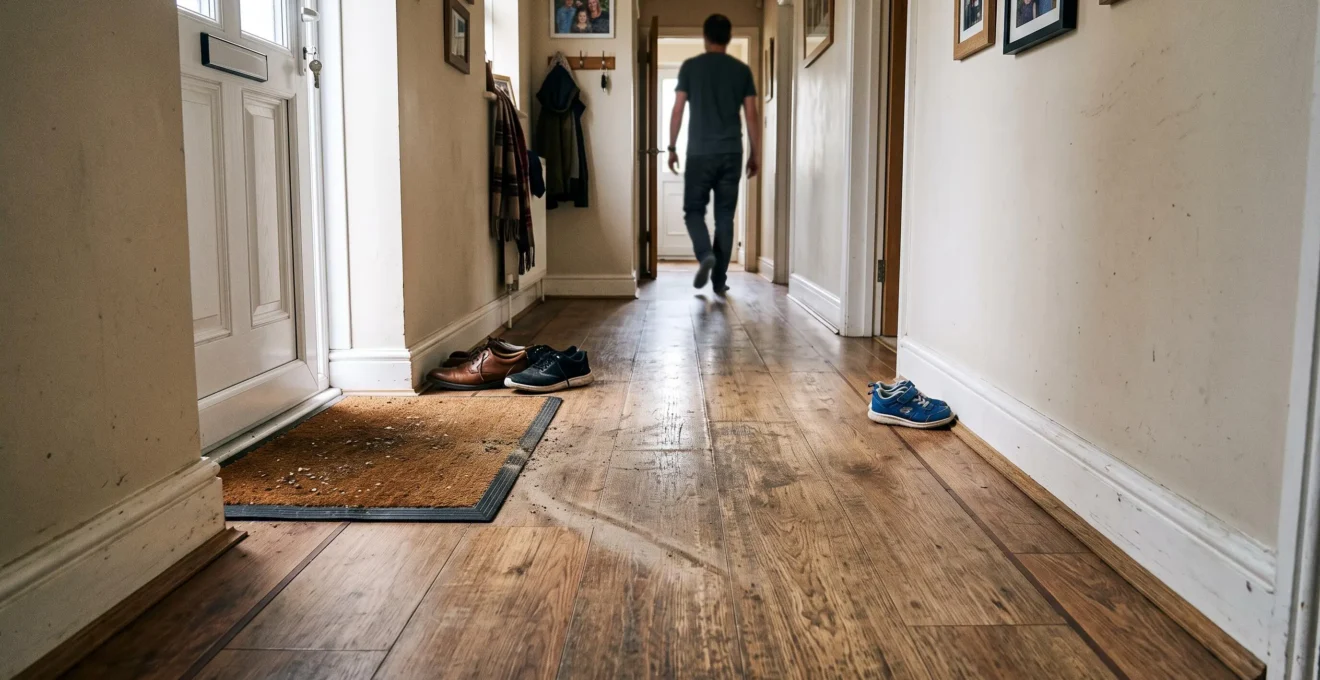
The best durable flooring for a high-traffic home depends on what actually happens in each room. Porcelain tile is often a strong choice for entrances exposed to grit and moisture. Quality luxury vinyl flooring can suit busy kitchens and family spaces where water resistance and comfort matter. Hardwood remains attractive where its repairability and long service life justify regular maintenance.
Yet no flooring material performs equally well against scratches, dents, standing water, repeated impacts and concentrated foot traffic. Even a hard-wearing surface can deteriorate prematurely if its installation, subfloor or cleaning routine is unsuitable.
The practical approach is to identify the dominant source of wear before comparing materials. A hallway that collects outdoor grit needs different protection from a kitchen exposed to spills or a family room where children and pets play. Surface finish, repair options and the cost of maintaining the floor matter alongside its initial durability rating.
Durable flooring: the essentials
- Match the material to the room: porcelain tile suits many wet or gritty entrances, while quality vinyl and properly finished wood can work well in busy living areas.
- Compare the right performance measures: abrasion resistance, moisture response, impact tolerance and repairability tell more than a generic durability claim.
- Protect the floor from everyday damage: effective entrance mats, suitable furniture protection and appropriate cleaning can substantially reduce avoidable wear.
- Why Does Flooring Wear Out Faster Near Entrances and Main Walkways?
- How Can You Compare Flooring Durability Before Renovating a Busy Room?
- Wood, Tile or Vinyl: Which Flooring Better Handles Children and Pets?
- Which Flooring Choices Can Fail Quickly in Wet or Gritty Areas?
- When Should Worn Flooring Be Refinished Instead of Replaced?
- How Can You Choose a Floor Finish for a Busy Hallway or Kitchen?
- When Can Continuous Flooring Become Impractical Between Different Rooms?
- Which Durable Floor Finishes Work Best in High-Traffic Rooms?
Why Does Flooring Wear Out Faster Near Entrances and Main Walkways?
Flooring wears out faster near entrances and main walkways because repeated footsteps concentrate abrasion, pressure and environmental exposure into narrow traffic lanes. Outdoor grit scratches protective surfaces, frequent loading stresses flooring materials, and moisture or sunlight near exterior doors can accelerate deterioration. The resulting damage depends on the flooring construction and how effectively the entrance is maintained.
Room size is a poor indicator of flooring wear. In a large living room, footsteps may be distributed across several routes. In a narrow hallway, almost everyone follows the same path between doors. That repeated contact can leave the centre visibly dull while the flooring along the walls remains comparatively unchanged.
Three mechanisms explain why these areas deteriorate differently:
- Abrasive wear: sand, soil and small particles trapped beneath shoes or furniture act against the flooring surface, gradually dulling or damaging its protective layer.
- Repeated mechanical loading: footfalls, wheeled furniture and movement over inadequately supported flooring can stress joints, locking systems and underlying materials.
- Moisture and light exposure: water tracked through an exterior doorway may affect seams and moisture-sensitive cores, while sunlight can change the appearance of susceptible finishes and materials.
It is important to distinguish cosmetic deterioration from damage that compromises the flooring itself. Light scratches or reduced sheen may leave a protective finish functional. Deep abrasion that penetrates the wear layer, exposes a decorative layer or damages the core is more serious and may require replacement.
The NALFA laminate flooring certification standards distinguish abrasion performance from scratch, impact and moisture-related performance. A laminate floor that performs well against superficial scratching is not automatically equally resistant to every other form of deterioration.
Entrance matting is one of the simplest preventive measures. An exterior scraper mat paired with an interior dirt-collecting mat can reduce the amount of abrasive material reaching the flooring. Regular removal of trapped grit is just as important as installing the mats.
Once the main wear mechanism is identified, the next decision is whether the proposed flooring has the right performance characteristics for that specific exposure.
How Can You Compare Flooring Durability Before Renovating a Busy Room?
Compare flooring durability by matching each material’s documented performance to the room’s traffic, moisture, abrasion and impact conditions. Laminate abrasion classifications, vinyl wear-layer specifications, wood hardness and tile abrasion ratings describe different properties and cannot be converted into one universal durability score. Installation requirements and the ability to repair damage should also influence the choice.
Begin with the product specification sheet rather than a showroom label such as “heavy duty” or “family proof.” A flooring sample shows colour and texture, but it cannot demonstrate how the product will perform after repeated exposure to grit, moisture or furniture movement.
Common performance indicators include:
- Laminate: AC abrasion ratings, where provided under the applicable test system, offer a useful comparison between laminate products. AC3 is commonly considered for general residential use, while AC4 or higher may be considered for demanding residential areas. These are selection guidelines, not predictions of lifespan.
- Luxury vinyl and LVT: wear-layer thickness helps describe the protective layer above the decorative design. Residential products may specify layers such as 12 mil or 20 mil, but thickness alone does not establish scratch resistance or overall product quality.
- Hardwood: the Janka hardness test measures resistance to indentation. It does not directly measure finish abrasion, moisture tolerance or scratch visibility.
- Ceramic and porcelain tile: PEI classifications, where specified, help assess the abrasion resistance of glazed tile surfaces. They should be considered alongside the tile’s intended-use classification and relevant manufacturer information.
Different standards may apply across English-speaking countries. Check whether a rating comes from an applicable ANSI, ASTM, ISO or EN test method rather than assuming similarly named ratings measure identical properties.
A room-based comparison is more useful than a simple ranking of materials.
| Room condition | Performance priority | Potential weakness to investigate |
|---|---|---|
| Frequent footsteps | Abrasion resistance and joint stability | Wear-layer erosion or movement at plank connections |
| Regular spills | Water resistance of the complete installation | Swelling, edge penetration or trapped subfloor moisture |
| Pets and children’s toys | Scratch, indentation and impact resistance | Gouges, dents, chipped tile or visible finish damage |
| Movable furniture | Surface protection and resistance to concentrated loads | Scratches, impressions or joint damage |
| Strong sunlight | Colour stability and installation movement allowances | Fading, discolouration or temperature-related movement |
Product warranties require separate scrutiny. A long warranty may exclude abrasive contamination, standing water, improper installation or unsuitable maintenance. Compare the actual coverage and exclusions rather than treating warranty duration as a direct measure of service life.
Five checks before ordering flooring
- Record the busiest walking routes and furniture movement in each room. Deliverable: an annotated room sketch identifying concentrated traffic lanes.
- Identify doors, sinks, appliances and other potential moisture sources. Deliverable: a room-by-room moisture exposure list.
- Check sunlight exposure and inspect the subfloor for unevenness or visible moisture damage. Deliverable: a written site-condition checklist for the installer.
- Collect technical specification sheets for shortlisted products. Deliverable: a comparison showing relevant wear ratings, construction and installation limits.
- Review cleaning instructions, repair options and warranty exclusions. Deliverable: a maintenance and replacement-risk summary for each finalist.
The strongest candidate is not necessarily the material with the highest advertised rating. It is the product whose tested properties, installation requirements and maintenance needs match the actual room.
Wood, Tile or Vinyl: Which Flooring Better Handles Children and Pets?
Porcelain tile generally handles repeated surface abrasion and common household spills well, while luxury vinyl provides a more forgiving surface for active family rooms. Hardwood can be durable and repairable but is vulnerable to scratches, dents and prolonged moisture exposure. For children and pets, the best choice balances damage resistance, comfort, cleaning requirements and future repair costs.
Children and animals create several distinct stresses. Pet claws can mark finishes, heavy toys can cause dents or chips, and spilled drinks or pet accidents can expose joints to moisture. A material that resists one problem may remain vulnerable to another.
| Material | Useful strengths | Main limitations | Repair considerations |
|---|---|---|---|
| Hardwood | Natural appearance, potentially long service life, refinishing options | Scratching, denting and moisture sensitivity | Recoating or sanding may be possible, depending on construction and condition |
| Porcelain tile | Strong abrasion resistance when appropriately specified, moisture tolerance and easy surface cleaning | Hard underfoot; tiles or grout may chip, crack or deteriorate | Individual tiles can sometimes be replaced if matching stock and access are available |
| Luxury vinyl | Resilient feel, straightforward maintenance and good surface-water resistance in suitable products | Potential gouging, permanent indentation and moisture entry through joints | Some plank systems permit local replacement, depending on installation |
Scratch resistance and dent resistance are not interchangeable. A relatively hard wood may withstand an impact better than a softer species, yet scratches can still show prominently in its finish. Grain pattern, colour and sheen also affect how noticeable damage becomes.
Likewise, a scratch-resistant vinyl surface can be permanently gouged by sharp objects or damaged by inappropriate furniture feet. Tile resists many everyday surface marks, but a sufficiently concentrated impact can chip a tile or damage its edges.
Comfort changes the decision. Tile can feel cold and unforgiving to toddlers playing on the floor or older pets resting and walking on hard surfaces. Resilient vinyl is generally softer underfoot, while wood offers a different balance of warmth and firmness.
Consider what happens after an accident. A wood floor with sufficient usable surface thickness may be repairable through professional refinishing. A damaged vinyl plank might be individually replaceable, while a cracked tile may require removing and replacing the affected unit without damaging neighbouring tiles.
These repairs are not automatically simple. Adhesives, locking-system geometry, matching materials and the location of damage can affect labour and feasibility.
Where accidents and spills are frequent, moisture performance deserves particular attention before selecting the final material.
Which Flooring Choices Can Fail Quickly in Wet or Gritty Areas?
Traditional laminate, insufficiently protected wood and poorly installed flooring systems can deteriorate quickly where water or abrasive grit is frequent. Some vinyl products resist surface water but cannot prevent moisture from reaching the subfloor through joints or edges. Tile generally tolerates wet conditions well, although grout, substrate moisture and slip resistance still require attention.
The failure mechanism matters more than the word “waterproof” on the packaging. A plank may remain dimensionally stable after surface exposure while water passing through its joints damages the underlayment or subfloor.
In moisture-prone areas, common risks include:
- Laminate: susceptible products may swell along seams when water reaches a moisture-sensitive core. Some newer systems provide improved water-resistance performance, subject to their tested limits.
- Wood: repeated wetting can cause staining, movement, cupping or distortion, especially where moisture reaches vulnerable board edges or the underside.
- Vinyl: a water-resistant plank does not necessarily create a watertight floor assembly. Water may penetrate through joints, perimeter gaps or transitions.
- Tile: the tile body may tolerate water while grout, movement joints, waterproofing and underlying construction determine how the complete installation performs.
The EPA home remodeling and indoor air quality guidance highlights the importance of considering water penetration beneath flooring, where trapped moisture can contribute to damage and difficult-to-remediate conditions.
Grit introduces a separate problem. Sand and small stones trapped beneath footwear act as abrasive particles, especially where movement repeatedly follows the same route. Mudrooms, exterior entrances and garage-adjacent corridors need a surface that tolerates frequent cleaning as well as abrasion.
Textured porcelain tile can be practical in these locations when its abrasion rating, intended use and cleaning requirements are suitable. Quality commercial-oriented resilient flooring may also be worth assessing where a softer surface is preferred. Texture alone, however, does not establish abrasion resistance.
Slip-related performance requires its own assessment. The Tile Council of North America explains that hard-surface flooring classifications consider intended exposure conditions, and that a laboratory friction measurement cannot independently predict whether someone will slip.
Before replacing flooring affected by persistent dampness, investigate the source. A plumbing leak, water intrusion through a doorway or moisture rising from the substrate will not be resolved by covering the surface with a water-resistant product.
When moisture has already caused visible deterioration, repairability becomes the next question: some floors can be restored, while others require partial or complete replacement.
When Should Worn Flooring Be Refinished Instead of Replaced?
Refinishing is usually appropriate when real wood flooring has cosmetic or recoverable surface damage and enough usable material remains for the required treatment. Replacement becomes more likely when boards are structurally damaged, severely distorted or worn beyond their repair limits. Laminate and most vinyl flooring cannot be sanded and refinished like genuine wood.
The first diagnostic step is to establish whether the damage affects only the finish or extends into the flooring material.
A dull surface with fine scratches may need cleaning and a maintenance coat rather than aggressive sanding. Deep gouges, extensive finish loss or exposed wood may justify more substantial refinishing, provided the flooring is suitable.
According to the NWFA recommendations for refinishing wood floors, maintenance coating and full sanding are different treatments. The National Wood Flooring Association also notes that sanding feasibility depends on wear-layer thickness, floor condition, flatness, equipment and professional technique.
This distinction is especially important for engineered hardwood.
- Solid hardwood: may accommodate repeated sanding over its service life, depending on remaining usable wood and existing damage.
- Engineered hardwood: refinishing potential depends partly on the thickness of its real-wood surface layer. Some products may not be suitable for conventional sanding.
- Laminate: sanding would normally remove or damage its decorative and protective layers rather than restore them.
- Vinyl: most residential products are not designed for wood-style sanding and refinishing; damaged sections generally require an appropriate repair or replacement method.
Repair costs should be assessed against the condition of the whole floor. Refinishing can preserve existing wood and avoid the disruption of removing it, but no fixed cost advantage applies to every project. Labour, preparation, furniture removal, repair work and finish selection all influence the final estimate.
Refinishing restores a usable surface; it does not correct an unsuitable flooring specification. If a relatively delicate finish continues to receive heavy abrasive traffic, the same wear pattern may return unless the maintenance routine or protective measures change.
Timing also matters. Addressing worn finish before bare wood becomes extensively damaged can preserve more repair options. By contrast, severe moisture distortion or material deterioration may make sanding inappropriate.
A flooring professional should examine uncertain wear-layer thickness, cupping, movement and previous sanding before recommending major work.
Once the floor is confirmed repairable, choosing a suitable finish helps determine how well the restored surface handles future traffic.
How Can You Choose a Floor Finish for a Busy Hallway or Kitchen?
Choose a floor finish for a busy hallway or kitchen by considering abrasion exposure, moisture, appearance and the maintenance routine the household can sustain. Film-forming polyurethane finishes provide a protective coating over suitable wood, while penetrating oil systems may permit more localised maintenance. For tile and vinyl, surface texture, sheen and manufacturer-rated performance are particularly important.
Wood finishes differ not only in how they resist wear but also in what happens after damage.
Polyurethane-based finishes form a protective film over the wood. Depending on the product and condition, the film may be maintained through compatible recoating or require more extensive preparation when deterioration becomes significant.
Penetrating oil finishes interact differently with the wood surface. Certain systems allow worn areas to be cleaned and refreshed locally, although they may require more frequent maintenance and careful adherence to product-specific instructions.
Neither category is automatically superior. The best choice depends on the exact formulation, expected traffic, compatibility with the flooring and the household’s willingness to maintain it.
Sheen strongly influences how quickly wear becomes noticeable. High-gloss finishes can reveal fine scratches, dust and differences in reflected light. Matte and satin finishes often make everyday marks less conspicuous, even when the actual surface wear is similar.
For vinyl and tile, the appearance-versus-cleaning trade-off also matters:
- Matte finishes tend to conceal minor marks more effectively than highly reflective surfaces.
- Embossed or textured surfaces can reduce the visibility of traffic patterns but may retain dirt in recesses.
- Polished surfaces may be easier to wipe in some circumstances yet show streaks, scratches or changes in sheen more readily.
- Surface texture must be considered alongside wet-use suitability rather than treated as proof of slip resistance.
In potentially wet kitchens and entrances, the Tile Council of North America‘s DCOF technical FAQ explains how ANSI A326.3 classifies hard-surface products by intended conditions of use. The guidance also makes clear that friction testing cannot guarantee slip prevention in every real-world situation.
Maintenance should influence the finish selection before purchase. Some wood finishes have specific cleaner requirements. Abrasive cleaning tools may dull protective coatings, while inappropriate detergents can leave residues on tile or resilient surfaces.
A household that can remove grit frequently and manage spills promptly may keep a suitable finish performing well for longer than one relying on occasional intensive cleaning.
Where adjacent rooms have different moisture and traffic conditions, the next challenge is deciding whether the same flooring should continue uninterrupted between them.
When Can Continuous Flooring Become Impractical Between Different Rooms?
Continuous flooring becomes impractical when adjoining rooms have substantially different moisture, traffic or substrate conditions, or when the flooring manufacturer’s installation limits require movement joints or transitions. A single uninterrupted surface can create visual unity, but it may also force compromises in durability, repairability and installation performance.
An open-plan layout encourages the use of one material from room to room. Yet a quiet bedroom, a frequently used corridor and a spill-prone kitchen rarely place identical demands on their floors.
If the same material is installed everywhere, it must be suitable for the most demanding location along the continuous route. That may increase costs in low-traffic rooms without providing a meaningful practical benefit there.
Alternatively, selecting a less durable floor for visual consistency may leave the hardest-working areas exposed to premature deterioration.
Technical restrictions also influence the decision.
- Expansion and movement: floating flooring systems generally require perimeter allowances, and some installations need additional breaks depending on dimensions, layout and manufacturer requirements.
- Doorways: transitions can accommodate differences in movement behaviour between spaces and may simplify future local replacement.
- Subfloor changes: variations in level, substrate construction or surface condition may require preparation or a suitable transition detail.
- Installation direction: long runs, complex room shapes and flooring-system requirements can affect plank layout and permissible continuity.
A change in moisture exposure is particularly important. Extending wood flooring from a living room into a bathroom introduces a different risk profile, while a kitchen connected to a dry hallway may require closer consideration of spills and appliance leaks.
Transitions can therefore serve a functional purpose rather than merely interrupting the appearance of the floor. A carefully selected threshold can separate materials with different installation requirements while creating a deliberate visual boundary.
Practical example: an open-plan family home
Consider a hypothetical home with a tiled exterior entrance, a central hallway and an open-plan living area. The entrance receives wet shoes and outdoor grit, while the living area is mostly dry and used for play and relaxation.
Using suitable tile at the entrance and a resilient wood-look floor in the living area could address these different stresses without requiring one material throughout. A properly designed transition would accommodate the flooring systems and provide a clear maintenance boundary.
Continuity still makes sense where adjoining rooms share similar conditions and the selected product permits the planned installation. Consistent flooring can simplify cleaning, reduce visual fragmentation and avoid unnecessary thresholds.
The final specification should therefore be made room by room, even when several rooms will ultimately receive the same material.
Key takeaways before choosing
- Identify the dominant stress in each room—abrasion, moisture, impacts or concentrated furniture loads—before comparing flooring finishes.
- Include repairability and maintenance in the budget rather than judging products solely by initial installation cost.
- Confirm installation limits and protect vulnerable joints, entrances and traffic lanes from the beginning.
Which Durable Floor Finishes Work Best in High-Traffic Rooms?
Durable finishes work best when their protective characteristics match the main stresses of a particular room. Matte, suitably rated porcelain tile is often practical for gritty or wet entrances; quality resilient vinyl can serve busy kitchens and family spaces; and properly finished hardwood can perform well where moisture is controlled and future refinishing is valued. Installation quality and maintenance remain essential in every case.
The most practical approach is to choose the flooring system and surface finish together. A good finish cannot overcome an unsuitable core, inadequate subfloor preparation or an installation that ignores movement and moisture requirements.
| High-traffic area | Suitable options to evaluate | Main selection priority |
|---|---|---|
| Exterior entrance or mudroom | Matt or textured porcelain tile; suitably rated resilient flooring | Abrasion, wet-use suitability and easy grit removal |
| Busy kitchen | Porcelain tile; water-resistant luxury vinyl flooring | Spill management, surface durability and subfloor protection |
| Main hallway | Durable laminate, quality vinyl or suitably finished hardwood | Repeated abrasion, joint performance and repair options |
| Family living room | Luxury vinyl, engineered hardwood or solid hardwood | Comfort, impact resistance, appearance and maintainability |
| Pet-heavy circulation space | Durable resilient flooring or appropriately rated tile | Scratch tolerance, cleaning and practical repair access |
These combinations are starting points rather than product guarantees. Compare technical specifications and installation instructions for each shortlisted product, especially when the room has unusual exposure conditions.
Purchase cost is also only one component of the decision. A cheaper floor that needs frequent section replacement may ultimately cost more than a product with a higher initial price and an appropriate maintenance strategy. Equally, a premium surface that requires extensive professional repair may be less economical than a moderately priced system permitting local repairs.
For a meaningful ownership comparison, include material and installation costs, expected maintenance, potential repairs, disruption during repairs and the availability of matching replacement material. Any projected ten-year cost should use actual quotations and clearly stated assumptions, not a generic lifespan claim.
Preventive maintenance is part of the flooring specification. It deserves the same attention as finish colour or wear-layer thickness.
Useful protective measures include removing grit before it reaches circulation paths, fitting compatible felt pads beneath movable furniture, choosing appropriate castors or chair protection, and using only cleaning products approved for the surface.
Where spills occur, remove them promptly and inspect vulnerable edges. In entrance zones, clean mats regularly so accumulated grit does not become another abrasive surface.
Periodic inspections can also prevent minor defects from turning into expensive repairs. Look for worn protective finishes, lifting plank edges, cracked grout, damaged joints and movement at transitions. For wood flooring, timely maintenance coating may preserve the possibility of less invasive restoration. For modular flooring, replacing a damaged unit before adjacent materials deteriorate may limit the scale of the repair.
Keep leftover material when practical and store the flooring specifications, finish information and maintenance instructions. These records make future repairs and compatible product selection easier.
Before ordering, identify the busiest traffic lane, the most likely source of moisture and the damage that would be hardest to repair. Then compare suitable flooring systems against those three conditions, confirm their installation requirements and choose the finish the household can realistically maintain.
Is thicker flooring always more durable?
No. Total plank thickness can affect construction and installation characteristics, but it does not independently establish surface wear resistance. For vinyl, examine the specified wear layer and relevant performance tests. For laminate, consider abrasion, impact and moisture ratings. Subfloor support and installation quality also affect long-term performance.
Can waterproof vinyl flooring be installed over a damp concrete subfloor?
Not automatically. A water-resistant vinyl surface does not remove the need to evaluate moisture within the concrete substrate. Excessive moisture can affect adhesives, underlayments and surrounding building materials. Follow the manufacturer’s applicable substrate testing and installation requirements, and resolve abnormal moisture sources before installation.
Does a matte finish resist scratches better than a glossy finish?
Not necessarily. Matte finishes often make fine scratches, dust and traffic-related changes in sheen less visible. Actual scratch resistance depends on the finish formulation, the underlying material and relevant product performance. Compare technical characteristics rather than assuming sheen establishes durability.
Should spare flooring planks or tiles be kept after installation?
Keeping suitable leftover flooring can make future local repairs easier, especially when a colour, pattern, production batch or product range becomes unavailable. Store spare materials according to the manufacturer’s recommendations. Their usefulness will still depend on whether the installed flooring system permits individual-unit replacement.
How can you tell whether a flooring problem comes from wear or poor installation?
Surface scratches concentrated along walking routes often indicate abrasion, whereas widespread joint separation, movement, lifting or irregular gaps may suggest installation, substrate or environmental issues. These symptoms are not conclusive on their own. Check the product requirements and seek an inspection when the cause is unclear, particularly before attempting repairs that could conceal underlying damage.