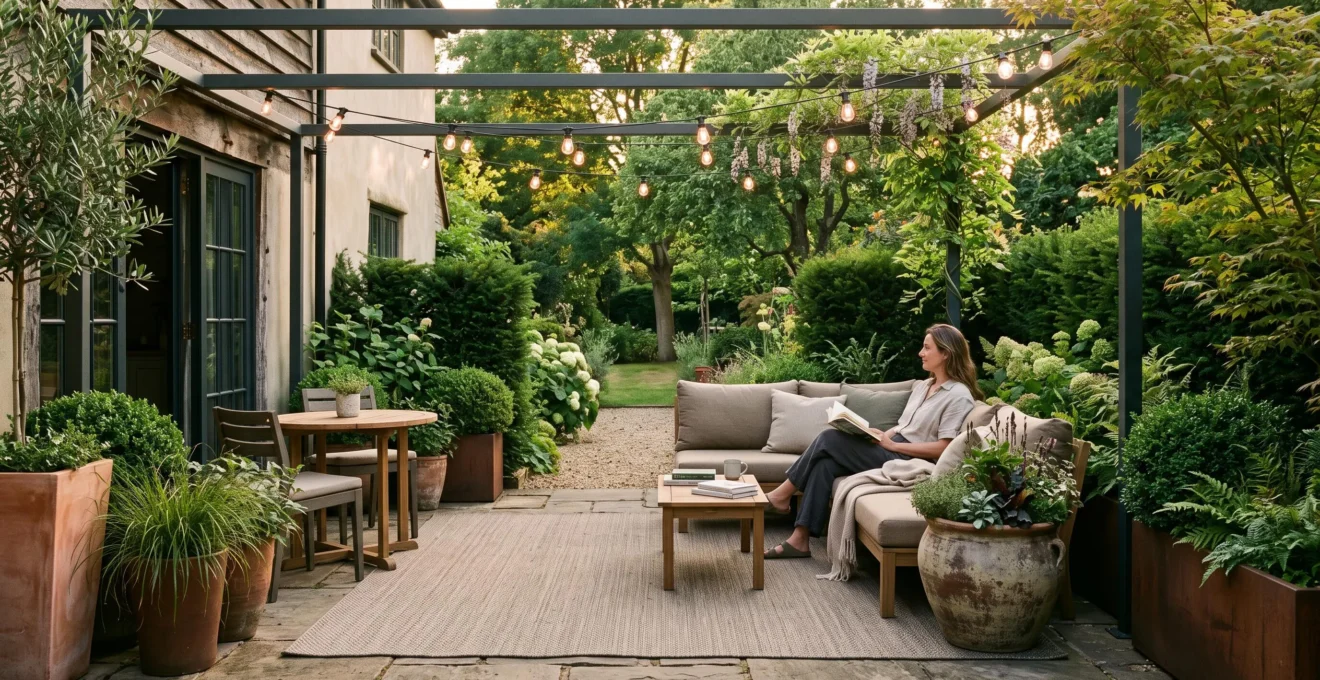
A patio becomes a genuine outdoor room when its layout supports everyday activities as comfortably as the rooms inside the house. Furniture provides somewhere to sit, but the feeling of a room comes from something more deliberate: recognizable boundaries, comfortable proportions, protection from the weather and a clear purpose for each area.
For a patio adjoining the house, the strongest designs begin with how people actually move between indoors and outdoors. A dining area near the kitchen door, a sheltered corner for reading and a clear route into the garden can make even a modest paved space feel purposeful. Planters, rugs, overhead shade and lighting then establish the visual character of each zone.
Creating that atmosphere does not necessarily require replacing paving or building permanent structures. The important decisions concern where activities happen, how exposed each seat feels and which materials will remain pleasant through the seasons. A practical design responds to the patio’s size, sunlight, rainfall and maintenance demands before introducing decorative details.
How to make a patio feel like a real outdoor room
- Define the space: Use planting, rugs, screens or low walls to establish boundaries without closing off the garden.
- Design around daily use: Keep circulation clear, position activities logically and provide shade where it matters.
- Build comfort in layers: Prioritize suitable seating, practical storage, weather-resistant textiles and lighting before adding decoration.
- Why Can a Furnished Patio Still Feel Unfinished or Uninviting?
- How Can You Arrange Seating and Dining Areas on a Small Patio?
- Hard Edges or Planted Borders: Which Makes a Patio Feel More Inviting?
- Which Patio Layout Mistakes Make Outdoor Spaces Harder to Use?
- What Should You Add First When Turning a Bare Patio Into an Outdoor Living Area?
- How Can You Compare Outdoor Upholstery Fabrics for Sun and Rain Exposure?
- How Can You Choose Native Plants for Sun, Shade and Different Soil Conditions?
- How Can You Choose Weather-Resistant Outdoor Upholstery That Still Feels Comfortable?
Why Can a Furnished Patio Still Feel Unfinished or Uninviting?
A furnished patio can feel unfinished because furniture alone does not establish the spatial cues associated with a room. Without a defined perimeter, some vertical enclosure and a recognizable focal point, seating may appear stranded on an open paved surface. Correcting these structural relationships usually matters more than introducing additional cushions, ornaments or accessories.
Indoor rooms automatically provide walls, ceilings and clear boundaries. Outdoors, those elements must be suggested through planting, architectural features and furniture placement. A tall planter can imply a wall, a pergola can define an overhead plane and an outdoor rug can visually establish the floor of a seating area.
Look for three missing layers:
- Perimeter: A visual edge distinguishing the patio from the surrounding garden, lawn or circulation space.
- Vertical dimension: Plants, trellises, screens or architectural features that provide height and partial enclosure.
- Focal point: A garden view, coffee table, fireplace where appropriate, or another feature giving the seating arrangement a clear orientation.
Scale matters equally. A small sofa may look isolated on a broad expanse of paving, while oversized lounge furniture can overwhelm a narrow patio. Unlike an interior, an exposed terrace has no enclosing walls to help establish proportion. Furniture should therefore be assessed in relation to the entire paved footprint, rather than its dimensions alone.
A useful diagnostic is the seated sightline test. Sit in every proposed position and notice what fills the view. Does the arrangement face an attractive garden feature, or does it expose occupants to a driveway, blank fence or neighboring windows? A modest adjustment in orientation may improve the experience without requiring new furniture.
Hard surfaces can also make a patio feel visually and physically severe. Sun-exposed paving may become uncomfortably hot, while an absence of foliage and soft materials offers little sensory variety. An outdoor rug introduces texture, planters add movement and seasonal interest, and low-level lighting provides a more welcoming evening atmosphere.
Before purchasing more accessories, draw a simple floor plan. If the furniture appears scattered, circulation cuts through the seating group or no boundaries identify the main activity, the difficulty is structural rather than decorative.
Once those layers are recognizable, the next challenge is fitting daily activities within the space without compromising movement or comfort.
How Can You Arrange Seating and Dining Areas on a Small Patio?
Arrange a small patio by protecting circulation space first, then positioning dining near the house and relaxing areas toward the best light, shelter or garden view. When the footprint cannot comfortably accommodate both functions, a flexible seating arrangement with a multipurpose table is often more useful than two cramped furniture groups.
Begin with the route people naturally follow from the house to the garden, storage area or side gate. Door swings, steps and frequently used access points should remain unobstructed. The seating plan must fit around these movements rather than forcing people to navigate between chairs.
The RHS advice on creating a garden plan recommends recording boundaries, doors, fixed features and site measurements on a scaled drawing. Its approach provides a sound starting point for testing patio layouts before committing to permanent changes.
For compact patios, there are two practical arrangements:
- One hybrid zone: A dining-height table, comfortable chairs and perhaps a storage bench accommodate meals, conversation and casual working outdoors.
- Two mini-zones: A small dining set occupies the area nearest the house, while a separate bench or pair of lounge chairs faces the garden.
The right choice depends on household habits. A couple who regularly eat outdoors may benefit more from a comfortable dining setup than a dedicated lounge. A household that hosts occasional gatherings may value movable pieces that can be rearranged.
Furniture shapes also create different compromises. Round tables remove projecting corners and can make movement around them easier, although their seating capacity depends on diameter and chair design. Folding furniture frees space when stored but may offer less comfort. Built-in benches can use perimeter space efficiently, yet their position is difficult to change later.
Before purchasing, outline the intended furniture with painter’s tape or a garden hose. Include chair positions when occupied and when pulled back from the table. Walk the actual routes through the space and open nearby doors to check for conflicts.
This physical rehearsal reveals limitations that can be difficult to recognize from product photographs. Clearance requirements vary with furniture dimensions, users and accessibility needs, so test actual movement rather than relying on a universal spacing assumption.
If a proposed arrangement works only when every chair is pushed under the table, it is too crowded for normal use. Reduce the furniture footprint or combine activities in one flexible zone.
With furniture positioned around everyday movement, borders and planting can begin to make the different zones feel like places to spend time rather than isolated pieces on paving.
Hard Edges or Planted Borders: Which Makes a Patio Feel More Inviting?
Hard edges provide structure, while planted borders introduce softness, movement and seasonal character. Neither is inherently more welcoming in every setting. A combination often works well: low walls or raised planters establish a durable frame, while grasses, shrubs and climbing plants reduce exposure and create a more comfortable transition into the surrounding garden.
A low rendered wall can define the patio year-round and may provide additional seating if designed for that purpose. Raised beds create a strong boundary and can accommodate planting without interrupting the paved floor. However, extensive hard construction may make a small patio feel enclosed or visually heavy.
Planted borders behave differently. Foliage softens the transition between stone and garden, while changing leaves, flowers and movement contribute sensory interest. The disadvantages are equally practical: plants need establishment time, watering, pruning and occasional replacement.
The feeling of enclosure depends on what occupants can see while seated. A completely open patio may offer little privacy, whereas enclosing every side with tall solid structures can sacrifice light and outward views.
One possible design approach is a one-and-a-half-wall arrangement: use a solid boundary on one side, partial screening on another and more open planting elsewhere. This is a flexible design concept, not an established technical standard. Its effectiveness depends on the patio’s orientation, surrounding buildings and desired privacy.
Where there is no space for an in-ground border, tall containers and climbing supports provide immediate vertical definition. The RHS planting ideas for small spaces describe how pots, vertical surfaces and plants at different heights can add greenery without occupying excessive ground space.
Clipped evergreens can provide dependable form through much of the year, while ornamental grasses introduce looser movement. Their suitability depends on climate and growing conditions, and not all grasses remain attractive or evergreen in winter.
Maintenance should influence the final decision. Leaves, fallen flowers and displaced compost need clearing from paving. Vigorous roots may require management near joints and built structures, depending on species and construction. Planters should not obstruct drainage or trap persistent moisture against the house.
Once the patio has recognizable boundaries, practical layout errors become easier to notice—particularly those affecting access, exposure and routine upkeep.
Which Patio Layout Mistakes Make Outdoor Spaces Harder to Use?
The most disruptive patio layout mistakes involve blocked walking routes, seating exposed to uncomfortable weather, insufficient storage and furniture groups without a clear visual anchor. These problems often develop when a space is arranged for appearance rather than everyday use. Testing circulation and observing the patio throughout the day can prevent many of them.
A visually appealing dining set can become frustrating when its chairs block the doorway. Likewise, a lounge arrangement may seem spacious until someone needs to reach the garden gate. Furniture should accommodate the natural paths between the house, garden and utility areas.
Pay particular attention to doors that swing outward, steps and locations where several routes intersect. Avoid placing large planters or storage units in these areas simply to create symmetry.
Another common mistake is choosing furniture positions without studying sunlight and wind. A dining table in direct afternoon sun may be uncomfortable during warm weather, while a bench positioned in the prevailing wind may rarely be used.
Observe the patio at breakfast, midday and evening before settling on a permanent layout. Notice where shade falls, whether neighboring buildings block late sunlight and which corners offer protection. Seasonal changes matter too: the sun’s position and the amount of shade from deciduous trees vary through the year.
Storage is part of the layout, not an afterthought. Cushions, throws and outdoor accessories need a convenient dry location. If storing them involves carrying everything across the house, the space may be less attractive to use regularly. A suitable storage bench or nearby weather-protected cabinet can make daily setup easier.
Finally, avoid leaving every furniture group floating in the middle of the paving. An outdoor rug, pergola structure, planter arrangement or appropriately positioned table can establish a clear anchor for each activity zone.
Five checks before finalizing your patio layout
- Map movement: Draw the routes between doors, gates and garden access points, producing a circulation sketch with no furniture obstructions.
- Test furniture footprints: Mark tables and chairs on the paving and photograph the arrangement with seats pulled out.
- Record exposure: Note sunny, shaded and windy positions at different times, creating a simple site-observation record.
- Assign storage: Identify where every loose cushion and accessory will go, producing a realistic storage plan.
- Choose one anchor per zone: Identify the rug, planter, table or structural feature defining each activity, then annotate it on the final layout.
These checks also help distinguish issues that require construction from those that can be resolved by repositioning furniture. Testing first reduces the risk of committing to an inconvenient arrangement.
Once movement, exposure and storage are resolved, the next decision is which additions will deliver the greatest improvement in comfort.
What Should You Add First When Turning a Bare Patio Into an Outdoor Living Area?
Start by defining the main activity zone and its boundaries, then introduce suitable seating, shade, lighting and soft furnishings. This sequence creates a usable outdoor room before decorative details accumulate. In exposed climates, shade and weather protection may need to move ahead of furniture upgrades because they directly affect when the patio can be enjoyed.
The first purchase should respond to a specific problem. An exposed seating area may benefit from a tall planter or freestanding screen. A patio that becomes too hot in the afternoon may need a parasol before additional furniture. A small space used mostly for evening conversation may benefit from comfortable seating and accessible lighting.
As a general sequence, work through five priorities:
- Define the zone: Establish where seating belongs using an outdoor rug, existing wall, planted containers or another clear boundary.
- Choose essential seating: Select the minimum furniture needed for regular occupants and their preferred activities.
- Provide suitable shade: Consider a parasol, shade sail or pergola according to exposure, available space and installation requirements.
- Add layered lighting: Combine practical illumination near doors and steps with gentler lighting around the seating area.
- Introduce textiles: Add cushions and throws suited to local weather and realistic storage habits.
Shade deserves particular attention. A beautifully furnished patio may remain unused during sunny periods if occupants have nowhere comfortable to sit. The appropriate solution depends on sun direction, wind exposure, fixing points and the ability to retract or secure the shade when conditions change.
For a simple one-weekend improvement, begin with an existing paved area that has adequate drainage and safe access. Define a seating group with a suitable outdoor rug, introduce comfortable weather-resistant seating and position one substantial planter to create height and a visual boundary. Finish with appropriately rated outdoor lighting installed according to its instructions.
This modest arrangement addresses three essential experiences: physical comfort, a recognizable spatial edge and a welcoming atmosphere after daylight fades. It also provides an opportunity to observe how the area performs before committing to larger structures.
Buying a complete matching furniture collection immediately can limit future flexibility. Actual use may reveal that a larger dining surface, additional shade or easier storage matters more than another lounge chair. Modular, movable pieces allow the arrangement to evolve.
After the essential layout is functioning, the durability of outdoor fabrics becomes a more important decision, especially where seating remains exposed to sunlight and rainfall.
How Can You Compare Outdoor Upholstery Fabrics for Sun and Rain Exposure?
Compare outdoor upholstery fabrics separately for resistance to ultraviolet exposure, water penetration and mildew-related problems. A material may resist fading while allowing water through, or shed light rain while retaining moisture inside the cushion. The best choice depends on direct sunlight, rainfall, shelter and whether cushions will be brought indoors between uses.
The label « weather-resistant » is too broad to establish how a fabric will perform. Three characteristics deserve individual attention:
- UV and fade resistance: How well the material and its color withstand prolonged sunlight.
- Water resistance: Whether the surface repels water, allows moisture to pass through or incorporates a waterproof barrier.
- Mildew resistance: How the fabric and cushion construction cope with moisture, dirt and drying conditions.
Solution-dyed acrylic is often considered for sun-exposed upholstery because the pigment is incorporated into the fibers during manufacture. However, individual product performance and warranty coverage should still be checked rather than inferred from the fiber name alone.
Polyester fabrics, including coated options, can offer a more affordable choice. Their suitability varies substantially by construction, treatment and exposure; a low price does not establish a particular service life. Olefin and other synthetic upholstery fabrics also deserve consideration where manufacturers document their intended outdoor performance.
Textilene-style open-mesh materials are often used for supportive sling seating rather than conventional padded upholstery. Their ventilation characteristics may suit certain environments, but they should not be treated as interchangeable with quick-dry foam. The foam, cover, seams and cushion base all influence how moisture behaves.
The following comparison is a practical selection framework, not a laboratory ranking of particular products.
| Material or construction | Potential advantage | What to verify |
|---|---|---|
| Solution-dyed acrylic fabric | Color retention for exposed seating | Product-specific UV performance, water behavior and warranty exclusions |
| Coated polyester upholstery | Varied styles and budget options | Coating durability, fading coverage and cleaning instructions |
| Olefin upholstery | Potential balance of softness and outdoor suitability | Actual weave, tested performance and care requirements |
| Quick-dry foam with a suitable cover | Improved drainage and drying compared with poorly ventilated cushion constructions | Complete cushion design, exposure suitability and drying conditions |
| Outdoor mesh sling seating | Ventilation without thick padded cushions | Frame quality, material specifications and preferred seating comfort |
When examining a specification sheet, look for clearly described UV testing, fabric water-repellency treatments, cleaning requirements and written warranty terms. A multi-year fading warranty may be a useful signal of manufacturer confidence, but its value depends on the conditions, exclusions and remedies provided.
A covered patio and an exposed, south-facing patio have very different demands. Under a roof, occasional moisture and indirect light may be the principal concerns. Uncovered seating faces more persistent sunlight, rain and drying cycles. Select fabrics for the actual microclimate rather than a generic outdoor-use category.
Fabric performance is only one aspect of a comfortable outdoor room. Planting must also suit its exposure, particularly when containers define the boundaries around upholstered seating.
How Can You Choose Native Plants for Sun, Shade and Different Soil Conditions?
Choose native patio plants by identifying growing conditions before selecting species. Record direct sunlight, examine soil drainage and distinguish exposed containers from in-ground borders. Native plants can support locally adapted ecosystems, but their success still depends on matching individual species to the exact moisture, soil and temperature conditions of the planting position.
Begin by observing the patio over several days, ideally including different weather conditions. Record where sunlight falls and distinguish exposed edges from shaded areas near walls, fences and overhanging structures. An observation period of approximately one week can provide a useful initial picture, although seasonal changes require additional consideration.
For in-ground borders, examine the soil rather than judging it only by surface appearance. Clay-rich ground may hold water, sandy ground may drain quickly and compacted soils can restrict movement of both air and water. A simple drainage observation after watering or rainfall helps identify areas that stay saturated, but it does not replace a full soil assessment where serious drainage problems exist.
Plant selection can then follow a practical grid:
| Growing position | Plant characteristics to seek | Important consideration |
|---|---|---|
| Full sun and rapidly draining soil | Locally native species adapted to open, relatively dry habitats | Heat reflected from paving and watering during establishment |
| Partial shade beside a wall or fence | Native woodland-edge or partial-shade species suited to local conditions | Rain shadows, root competition and seasonal sunlight |
| Deep shade | Regionally appropriate shade-tolerant plants | Reduced flowering potential for sun-loving species and possible dry soil |
| Moist ground or low-lying borders | Native species adapted to consistently moist soil | Difference between moist, well-aerated soil and persistent waterlogging |
| Exposed patio containers | Suitable native plants with manageable mature size and adaptable root systems | Faster drying, root temperature changes and container drainage |
Because native species differ between English-speaking regions, no single planting list applies equally to the United Kingdom, North America, Australia and New Zealand. A reputable local native-plant nursery or regional conservation organization can help establish which plants genuinely belong to the local flora.
Native plants may benefit pollinators and other wildlife that have ecological relationships with them. However, being native does not guarantee low water consumption or suitability for every garden. A wetland native planted in an exposed, dry container may need substantial irrigation.
Container gardening introduces additional constraints. Pots expose roots to more pronounced temperature changes, and their restricted growing medium can dry out faster than surrounding garden soil.
The RHS advice on growing plants in containers explains the importance of drainage, appropriate growing media, container size and seasonal protection. It also notes that container-grown plants generally require more regular care than those growing in open ground.
Large containers may provide more stable moisture conditions than small pots, but they still need appropriate drainage holes. The material of the container matters: metal may heat considerably in sunlight, while terracotta can dry quickly and may be vulnerable to winter damage.
Place taller plants where they provide screening without blocking essential views or access. Allow for their mature dimensions, not merely their size at purchase, and consider leaf fall and cleaning requirements along the paving.
With planting and boundaries established, upholstery becomes the final comfort layer: it should feel pleasant during use and remain manageable throughout changing weather.
Key decisions before choosing outdoor upholstery
- Match cushion construction to the way the patio is actually used, including whether seating stays outdoors during rain.
- Evaluate comfort through seat dimensions, support and fabric feel rather than judging material durability alone.
- Choose maintenance demands that fit household routines; storage and drying habits can be as important as fabric selection.
How Can You Choose Weather-Resistant Outdoor Upholstery That Still Feels Comfortable?
Comfortable, weather-resistant outdoor upholstery combines an appropriate fabric with supportive cushioning, suitable seat dimensions and manageable maintenance. Durability and softness are not necessarily opposing qualities. A well-designed cushion can use a pleasant-to-touch outdoor textile while relying on its foam, seams and drainage construction to improve performance in changing weather.
A stiff outdoor chair is not always the result of waterproofing. Seat angle, cushion thickness, foam density and fabric weave all influence how upholstery feels. A smooth, flexible solution-dyed acrylic or olefin cover may be comfortable, while a poorly proportioned cushion can feel uncomfortable regardless of its fabric.
For lounge seating, examine the depth of the seat and the support offered by the back cushions. Deep seating may encourage reclining but can be uncomfortable for shorter occupants without additional support. Dining chairs generally benefit from a more upright posture and cushions that do not interfere with movement at the table.
When evaluating furniture in person, sit long enough to assess support beyond the first impression. Notice whether the cushion compresses excessively, whether the seat edge presses into the legs and whether the backrest supports a natural position.
For online purchases, use a more deliberate checklist of product specifications:
- Seat height and depth appropriate for the intended occupants.
- Cushion thickness and filling construction, not simply the fabric name.
- Removable covers with accessible closures where appropriate.
- Clear cleaning instructions for both textile and cushion assembly.
- Product information addressing exposure, drainage and storage requirements.
Removable covers can simplify cleaning, but a zipper does not automatically mean a cover is machine washable or intended to be removed by the consumer. Follow the furniture manufacturer’s specific instructions to avoid damaging the cushion or compromising its shape.
Long-term comfort depends heavily on cleanliness and moisture management. Dust, pollen, food residue and organic debris can accumulate on textiles, creating conditions in which mildew may develop even where the underlying fabric resists microbial growth.
Manufacturers such as Sunbrella provide material-specific care guidance that distinguishes between removable and non-removable upholstery. Its recommendations include suitable cleaning procedures and allowing fabrics to dry thoroughly. These instructions should not be assumed to apply unchanged to other materials.
Outdoor cushions should be brushed or cleaned as directed, spills treated promptly and damp items dried before enclosed storage. Storing wet cushions in a sealed box can prolong moisture exposure and undermine the advantages of otherwise suitable materials.
The most important trade-off is therefore between convenience and the level of protection a household can reliably provide.
| Usage pattern | Comfort priority | Practical material and care priority |
|---|---|---|
| Cushions left outside during frequent use | Supportive seating that remains pleasant after changing weather | Quick-dry construction, appropriate mildew resistance and sufficient ventilation |
| Cushions stored after most uses | Greater freedom to choose softer fabrics and plush filling | Manageable cushion weight, accessible storage and easy handling |
| Covered patio with occasional rain exposure | Comfort suited to longer relaxation periods | Fabric appropriate to indirect exposure, condensation and occasional moisture |
| Sunny, uncovered dining area | Upright support and cushions that remain comfortable in warm conditions | Documented colorfastness, cleanability and suitable weather protection |
Even quick-dry cushioning requires suitable conditions to dry, and an outdoor fabric should not be treated as proof that the complete seat assembly is waterproof. Regular inspection of seams, filling and any trapped moisture remains worthwhile.
Choose the maintenance routine at the same time as the furniture. A softer cushion that is easy to carry indoors may provide a better experience for one household than a more exposed-weather-oriented design. Another household may value cushions that tolerate occasional unexpected rain and require less frequent handling.
Start with the seating zone that will be used most frequently. Test its position, shade and comfort, then choose fabric and cushions that match local exposure and everyday care habits. Once that combination works, the rest of the patio can develop around it without losing the practical qualities that make an outdoor room inviting.
Can an outdoor patio feel like a room without a pergola?
Yes. An outdoor rug, coordinated furniture arrangement, tall planters and a recognizable focal point can define a room-like seating area without a permanent overhead structure. A retractable parasol or suitable shade sail may provide overhead protection where needed, subject to safe installation and wind conditions.
How can you make a patio feel private without blocking sunlight?
Use partial screening rather than a continuous solid barrier. Open trellises, carefully positioned tall planters and planting at different heights can interrupt unwanted views while preserving some light and visual connection to the garden. Check the screening effect from seated positions and at different times of day.
Should outdoor rugs stay outside throughout the year?
That depends on the rug manufacturer’s instructions, the climate and drainage beneath it. Outdoor-rated materials may tolerate weather exposure, but prolonged dampness, trapped debris or insufficient drying can cause problems. Lift and clean rugs periodically, inspect the paving underneath and store them when required by the product instructions or seasonal conditions.
What is the easiest way to make a rented patio more inviting?
Focus on movable elements that do not require permanent alterations: freestanding planters, an outdoor rug, flexible seating, portable shade and suitable outdoor lighting. Ensure items are stable and that any electrical or structural installations follow applicable requirements and property restrictions. These additions can define a seating area while remaining relatively easy to relocate.
Can a patio work as an outdoor room in a rainy climate?
Yes, provided the design accounts for drainage, sheltered seating, weather-appropriate materials and convenient dry storage. Select cushions according to actual exposure and make sure furniture can dry after rainfall. A covered section or safely installed retractable shelter may extend usability, although protection from wind-driven rain can remain limited.