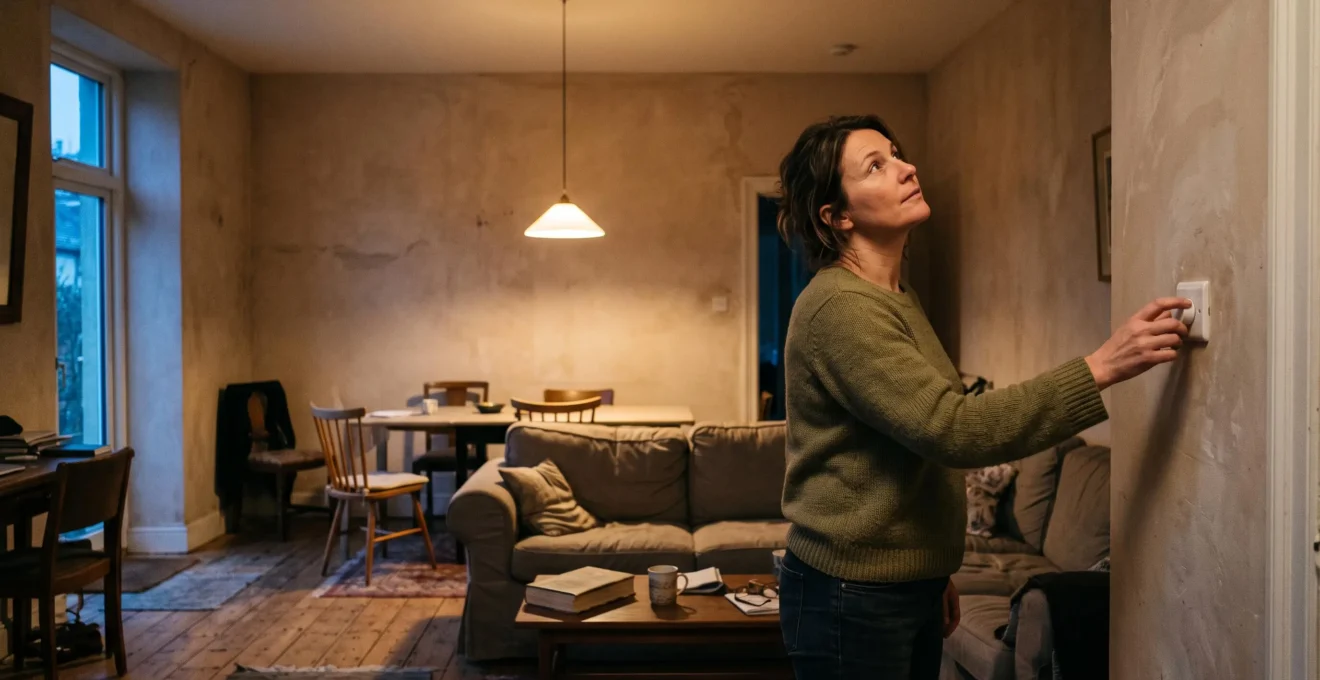
A dining room that feels bright and practical at breakfast can seem unnecessarily harsh during an evening meal. The ceiling light has not changed, but the activity has. Installing a dimmer switch can solve this mismatch without requiring another pendant, wall light or ceiling fitting.
Dimmer switches make one lighting scheme more versatile by allowing the same fitting to produce different levels of brightness. Higher output supports everyday activities, while reduced output creates a gentler atmosphere for dining, entertaining or relaxing. The adjustment can be made in seconds, provided the light source and control are compatible.
However, changing brightness is not the same as changing where light falls. A dimmer cannot eliminate shadows created by a badly positioned ceiling fitting or supply concentrated light to a distant reading chair. Understanding that distinction helps homeowners decide whether better control is sufficient or whether an additional task light is justified.
The most effective approach is to identify how a room is used, establish suitable light levels for those activities and choose controls that everyone in the household can operate comfortably.
Flexible lighting at a glance
- A compatible dimmer lets one existing lighting circuit serve several activities without adding fixed fittings.
- Brightness, colour temperature and light direction each influence comfort; dimming changes output but does not correct poor distribution.
- Check LED compatibility, minimum load and everyday control requirements before choosing a wall dimmer or smart lighting system.
- Why Does One Fixed Light Level Rarely Suit a Room All Day?
- How Can You Set Different Light Levels for Dining, Reading and Relaxing?
- Wall Dimmer or Smart Lighting Control: Which Is Easier for Everyday Use?
- What Can Go Wrong When Dimmer Switches Are Paired With Incompatible Bulbs?
- When Is Adding a Dimmer More Useful Than Replacing a Light Fitting?
- When Should You Reconsider a Room’s Lighting Layout?
- Adjustable or Fixed Task Lamp: Which Is Better for Flexible Use?
- How Can You Plan Interior Lighting for Both Practical Tasks and Evening Atmosphere?
Why Does One Fixed Light Level Rarely Suit a Room All Day?
One fixed light level rarely suits a room throughout the day because activities demand different amounts and distributions of light. Preparing breakfast, clearing a table and reading instructions generally benefit from stronger illumination, while conversation or evening relaxation often feels more comfortable with reduced brightness. A fixed-output ceiling light cannot respond to these changes without another control or light source.
Consider an open-plan dining and living area. During breakfast, sufficient illumination helps people see food preparation surfaces, table settings and everyday objects clearly. As daylight fades, the same ceiling light may provide useful general illumination for household tasks. Later, when the room becomes a space for conversation or watching television, that unchanged brightness can feel excessive.
The issue is not necessarily the light fitting. It may already distribute illumination adequately across the room. What is missing is the ability to adjust its output.
Ambient brightness and layered lighting solve different problems. Ambient lighting provides general visibility, while task and accent lighting direct attention to particular areas. A dimmer makes the ambient layer adjustable; it does not create new directions of light or independently illuminate different parts of a room.
Without brightness control, homeowners may avoid using the ceiling light in the evening and turn to table lamps instead. Other households tolerate full brightness simply because the switch offers no alternative. Both situations can indicate that the existing fitting is more useful than its fixed setting allows.
Daylight introduces another variable. A room with generous windows may need little artificial lighting in the afternoon but substantially more after sunset. Dark furnishings and curtains can also change the perceived brightness of the space.
The practical objective is therefore not to find one ideal light level. It is to establish a comfortable range that covers the room’s changing uses.
Once the required range is clear, the next decision is how to translate different activities into repeatable dimmer settings.
How Can You Set Different Light Levels for Dining, Reading and Relaxing?
Set light levels according to the visibility and atmosphere each activity requires. Dining often works well with moderate, warm illumination; reading usually needs stronger light on the page; and relaxing generally calls for lower ambient brightness. A compatible dimmer allows these adjustments through the same existing fitting, although a directional task light may still be necessary.
Begin by testing the lighting after dark, when changing daylight will not distort the comparison. Rather than choosing arbitrary percentages, move the dimmer until the intended activity becomes comfortable without excessive glare or unwanted shadows.
The following settings are practical starting points, not universal brightness specifications.
| Activity | Starting brightness | What to assess |
|---|---|---|
| Dining | Moderate, warm ambient light | Faces and food remain visible without a harsh overhead effect. |
| Reading or detailed tasks | Higher output, potentially with local task light | The page or work surface is clear without reflections or glare. |
| Relaxing | Low ambient output | The room feels comfortable while routes and surrounding objects remain visible. |
| Entertaining | Low to moderate output | Guests can move comfortably and see one another. |
A single dimmable pendant can often accommodate dining, casual conversation and general evening use. Where the existing scheme already includes independently controlled wall lights or another lighting circuit, separate dimming provides further flexibility without installing additional fittings.
For example, an existing pendant can remain moderately bright over a dining table while wall lights provide softer ambient illumination. The precise arrangement depends on how the circuits are wired and which lights support dimming.
For repeatable adjustments, photograph a slider at comfortable dining and relaxation positions, or note the corresponding dial positions. This simple reference is useful when the control has no scene-memory function.
Brightness and colour temperature must also be considered separately. A conventional dimmable LED may maintain essentially the same colour appearance as its output decreases. A purpose-designed warm-dim LED can shift towards a warmer appearance as it becomes less bright.
As a product-specific example, Signify‘s Philips Warm Glow G25 technical specifications describe a colour-temperature range of 2200–2700 K. This illustrates a warm-dimming capability, not a characteristic shared by every dimmable LED.
A warm-dim lamp can therefore change both the strength and appearance of illumination, while a fixed-colour LED primarily changes output. Both approaches can work if the resulting light suits the room.
After identifying comfortable settings, the remaining question is whether the household needs a straightforward manual control or a system that remembers them automatically.
Wall Dimmer or Smart Lighting Control: Which Is Easier for Everyday Use?
A conventional wall dimmer is generally the simpler option for immediate, everyday brightness adjustments. It provides a physical control without requiring an app or scene selection. Smart lighting is more flexible when a household wants saved settings, scheduling or coordinated lighting circuits, but its convenience depends on the products, configuration and available controls.
The distinction becomes obvious during ordinary transitions. When dinner ends and conversation moves to the sofa, turning a dial or moving a slider can reduce brightness immediately. A smart system may achieve the same result through a programmed scene, wall controller, voice command or mobile device.
For households that repeatedly use the same combinations of light levels, saved scenes may be worthwhile. For occasional adjustments, the simplicity of a conventional dimmer can be preferable.
| Everyday consideration | Wall dimmer | Smart lighting |
|---|---|---|
| Making a quick adjustment | Physical dial, slider or button | App, compatible switch, voice or scene control |
| Remembering settings | Manual on basic models | Saved scenes on supported systems |
| Coordinating circuits | Typically requires separate controls | Can coordinate compatible devices and groups |
| Installation and setup | Requires electrical compatibility and suitable installation | May involve device pairing, controls or additional hardware |
| Guest accessibility | Familiar physical operation | Most convenient with accessible wall controls |
| Network dependence | Basic local control does not need a network | Depends on the system and function |
Children, visitors and family members with different levels of technical confidence can usually understand a physical dimmer without instruction. A smart system can offer similar accessibility when it includes a suitable wall-mounted controller, rather than depending exclusively on an app.
However, smart bulbs and conventional phase-cut dimmers should not automatically be combined. Smart bulbs generally expect a suitable power supply and their own supported control method. Reducing their incoming voltage through an incompatible wall dimmer may cause unreliable operation.
Some households leave a conventional wall switch permanently on to keep smart bulbs available. That works only while power remains connected; switching the circuit off can interrupt remote control and scheduled operation.
Philips Hue‘s UK wall-switch compatibility guide illustrates how manufacturers distinguish conventional-light dimmers from modules intended for smart lighting. It also shows that neutral-wire and bridge requirements vary between devices.
A wired smart switch or compatible retrofit module can provide a middle ground: familiar wall operation alongside selected automated functions. Suitability depends on the specific device, electrical installation and regional requirements.
Choose control by the way the household uses the room, not simply by the number of available features. A wall dimmer often suits one existing circuit and straightforward manual use; smart control becomes more attractive when coordinated scenes or scheduling have a genuine purpose.
Whichever approach is selected, successful installation depends on matching the control technology to the light source rather than treating all dimmable products as interchangeable.
What Can Go Wrong When Dimmer Switches Are Paired With Incompatible Bulbs?
Incompatible bulbs and dimmer switches can produce flickering, buzzing, abrupt switching off, unstable low-level output or a restricted dimming range. These problems often occur when the dimmer’s control method or electrical load requirements do not suit the LED driver. A bulb marked dimmable is not necessarily compatible with every dimmer model.
Traditional incandescent lamps behave differently from modern LED lighting. Older leading-edge dimmers, commonly associated with incandescent and halogen loads, interrupt the incoming alternating-current waveform in a way that may not suit particular electronic LED drivers.
Trailing-edge controls are often used with suitable LEDs because their switching characteristics can provide better compatibility with some drivers. However, not every LED requires a trailing-edge dimmer, and not every trailing-edge dimmer works with every dimmable LED.
The manufacturer’s compatibility information is more dependable than a general assumption about dimmer technology.
A second problem is minimum load. An older dimmer designed around higher-wattage lamps may require more connected power than a small group of LED bulbs consumes.
For a hypothetical example, a circuit with two 5 W LED lamps has a connected lamp load of 10 W. Whether it operates correctly depends on the dimmer’s stated LED load range and the compatibility of those particular lamps. The equivalent incandescent wattage printed on packaging is not the relevant electrical load.
Compatibility becomes especially important when a multi-bulb fitting contains different lamp models or when a previously stable installation starts behaving unpredictably. Changes in performance may involve a deteriorating lamp, driver characteristics, connection issues or the control equipment itself. Flicker alone cannot establish the cause.
Manufacturers sometimes publish tested combinations for specific product families. Lutron‘s Caséta bulb compatibility FAQ describes manufacturer testing and provides compatibility resources for supported conventional lamps. It also distinguishes those lamps from smart bulbs that its Caséta dimmers are not designed to control directly.
Before buying a replacement control, record the exact bulb or integrated fitting model, check its dimming requirements and compare them with the intended dimmer’s documentation.
Verify the number of lamps, their actual electrical power consumption and any minimum or maximum load restrictions. For integrated LED fittings, the relevant information may concern the complete fitting and its driver rather than a replaceable bulb.
If buzzing, persistent flickering, unusual heat or unreliable switching occurs, stop using the affected dimming function and seek qualified electrical advice. Do not investigate live wiring or assume that changing the bulb will remedy every fault.
Once compatibility has been established, homeowners can make a more informed decision about whether adding control is worthwhile or replacing the existing fitting would solve the underlying problem more effectively.
When Is Adding a Dimmer More Useful Than Replacing a Light Fitting?
Adding a dimmer is more useful than replacing a fitting when the light already reaches the right areas but its fixed brightness does not suit different activities. A dimmer changes output while retaining the existing light distribution. Replacing a fitting becomes more appropriate when poor positioning, glare, unsuitable light spread or incompatible equipment is the actual problem.
Imagine a dining pendant that illuminates the table adequately for everyday meals but feels too bright when guests arrive. If its lamps or integrated LED system support compatible dimming, changing the control may achieve the desired flexibility without altering the pendant itself.
Conversely, a centrally positioned fitting that leaves a desk in shadow will still leave that desk poorly illuminated when dimmed. Replacing or repositioning the fitting, or providing local task lighting, addresses a different problem.
The distinction helps avoid purchasing a new decorative fitting when the existing one already performs its main job.
| Observed problem | More appropriate starting point | Reason |
|---|---|---|
| The room is too bright in the evening | Compatible dimmer | Overall output needs adjustment. |
| The fitting provides adequate light but no mood flexibility | Compatible dimmer | Controlling existing illumination may be sufficient. |
| One corner remains too dark | Review light distribution or add task lighting | Dimming cannot increase light in that corner. |
| A lamp shines directly into seated eyes | Reconsider placement, shielding or fitting design | Lower output may reduce discomfort but not eliminate the cause. |
| An integrated LED fitting does not support dimming | Investigate manufacturer-approved alternatives | Changing the wall control alone may not work. |
Before selecting a replacement dimmer, check the physical installation. A retrofit control may require more depth in the existing wall box. Smart dimmers may have additional wiring or neutral-conductor requirements, although these vary by product.
Ownership also matters. A homeowner can consider permanent changes subject to applicable electrical requirements. A renter should establish whether alterations are permitted and obtain the necessary approval before modifying fixed wiring.
Installation feasibility is as important as product choice. Some integrated LED systems require specific dimming interfaces or approved controls, while certain fittings and circuits are not intended for ordinary lighting dimmers.
Fans and other non-lighting loads must not be placed on a standard lighting dimmer unless the equipment and control are expressly designed for that application. Manufacturer instructions and warranty conditions should also be reviewed before making changes.
Although retaining a fitting can reduce the scope of work, the actual cost advantage depends on compatibility, wiring access and the labour required. It should not be assumed that every dimmer retrofit is cheaper.
If the existing light distribution is inadequate, the next step is to inspect the room’s layout rather than expecting brightness control to compensate for structural shortcomings.
When Should You Reconsider a Room’s Lighting Layout?
Reconsider the lighting layout when changing brightness cannot make important activities comfortable or safe. Persistent shadows, glare at seated eye level and work areas outside the useful spread of existing fittings suggest a distribution problem rather than a control problem. A dimmer can reduce or increase output within its supported range, but it cannot redirect light.
A common example is a single ceiling fitting located behind someone working at a desk or kitchen counter. The person may cast a shadow directly onto the surface. Raising brightness can increase the amount of light elsewhere without eliminating the obstruction.
Another example is a pendant that hangs in the direct line of sight from a sofa. Lowering the output might make the source less uncomfortable, but its position and shielding still influence glare.
These issues illustrate why light distribution matters alongside brightness. The CIE‘s indoor workplace lighting standard addresses illuminance, glare, colour rendering and visual comfort, recognising that lighting quality involves more than the quantity of light alone.
That standard concerns indoor workplaces, not domestic atmosphere. Its technical principles help explain visual-task needs, but it does not prescribe how homeowners should arrange decorative residential lighting.
A practical way to identify layout problems is to examine the room after sunset while performing its normal activities.
- Set the existing lights to the levels you would prefer for a typical evening.
- Move between the dining table, sofa, desk and other regularly used positions.
- Notice where objects become difficult to see, shadows interfere with tasks or a light source causes glare.
- Distinguish between areas that need more overall brightness and areas that need illumination from a different direction.
If changing the level improves comfort everywhere, better control may be sufficient. If one area remains difficult to use regardless of the dimmer position, a revised lighting arrangement deserves consideration.
Permanent changes might involve relocating ceiling points or installing separately controlled circuits. Less invasive alternatives include a plug-in reading lamp or a movable task light.
Evaluate distribution before finalising control. This does not mean every room requires several fittings. It means the existing scheme must already direct enough light towards the activities it is expected to support.
Where the general lighting is adequate but a particular activity needs more directed light, a flexible task lamp may solve the remaining problem without changing the room’s fixed electrical layout.
Adjustable or Fixed Task Lamp: Which Is Better for Flexible Use?
An adjustable task lamp is generally more flexible than a fixed lamp when one area supports several activities. Its movable head or arm lets the user direct light towards a book, keyboard or hobby project. A fixed lamp is simpler when the working position remains unchanged, but it offers less freedom to reposition illumination without moving the entire lamp.
Task lighting serves a different purpose from a dimmable ceiling circuit. The ceiling fitting establishes the general brightness and atmosphere of the room, while a task lamp concentrates light on an activity that needs greater visibility.
For example, a living room can retain a softly dimmed pendant while an adjustable reading lamp provides stronger illumination at one chair. This avoids raising the brightness of the whole room merely to make a page easier to read.
An adjustable arm is particularly useful when the same surface serves as a laptop workspace, drawing area and reading position. The light can follow the task instead of requiring the user to work wherever the beam happens to fall.
A fixed lamp may be preferable on a dedicated bedside table or other location where the direction and position of the light rarely change. Simplicity can be an advantage when repeated adjustment would add little value.
However, flexibility introduces a potential problem: a movable light can also be directed towards the user’s eyes or towards a reflective screen.
Position the lamp so it illuminates the work surface from the side or slightly behind the normal line of sight, while keeping the light source out of direct view. Adjust its angle to reduce reflections and shadows rather than simply choosing its highest output.
A multi-level or dimmable task lamp extends the usefulness of the same local light source. Stronger settings can support detailed work, while lower settings can provide gentle supplementary illumination in the evening.
The result is a practical division of responsibilities: the existing dimmable circuit manages the room’s general environment, and the task lamp supplies directional illumination only where it is needed.
With both ambient and local lighting needs understood, homeowners can make control decisions in a deliberate sequence rather than buying additional fittings before establishing what the room actually requires.
Key takeaways before planning your lighting
- Separate an output problem from a distribution problem: a dimmer solves the former, while the latter may require directional lighting.
- Choose controls around repeated household activities and the people who will use them, not around features that may remain unused.
- Confirm the compatibility and installation requirements of existing lights before purchasing controls or planning alterations.
How Can You Plan Interior Lighting for Both Practical Tasks and Evening Atmosphere?
Plan flexible interior lighting by identifying the room’s main activities, establishing the brightness and direction each requires, and then choosing compatible controls before buying new fittings. Use existing dimmable circuits for general illumination and introduce local task lighting only where distribution is insufficient. This creates adaptability without automatically increasing the number of installed lights.
Start with two or three activities that regularly take place in the room. In a dining and living area, these might be eating, reading and relaxing. In a combined kitchen and dining room, they might be food preparation, family meals and evening conversation.
Next, evaluate the existing lighting at night. Identify which activities already receive adequate illumination and which depend on a different beam direction. If the central fitting reaches all important surfaces, a compatible dimmer may offer much of the desired flexibility.
Where activities occur in separate corners, identify whether a portable light or an independently controlled existing circuit would be more useful than changing the overall room brightness.
Colour temperature should form part of the decision. Warm lighting is often suitable for living and dining areas, while task areas may benefit from a light source selected for their particular visibility requirements. Avoid combining conspicuously different light colours without considering how they will appear together.
Remember that reducing a standard fixed-colour LED’s brightness does not necessarily make its light warmer. If that effect matters, select a compatible warm-dim product specifically designed to provide it.
Five checks before buying a dimmer
- Record the room’s main activities. Write down two or three regular uses and the locations where they happen, producing a simple activity map.
- Test the existing illumination. Check the room after dark and note where brightness is excessive, light is insufficient or glare occurs, producing a list of observed problems.
- Identify the installed light sources. Record the bulb or integrated fitting model, its actual wattage and whether dimming is supported, producing a component inventory.
- Verify the proposed control. Compare manufacturer compatibility information, load requirements and relevant installation constraints, producing a confirmed product pairing or a list of questions for an electrician.
- Plan repeatable settings. Choose preferred levels for each activity and document dial positions or supported smart scenes, producing a household lighting reference.
Common purchasing mistakes include buying non-dimmable LEDs with the expectation that they can be dimmed later, selecting a control without checking its load range, or expecting one centrally positioned fitting to illuminate separate task areas equally well.
Room finishes also matter. Dark furnishings, heavy curtains and less reflective surfaces can make the same lighting output feel less effective than it does in a brighter interior. Assess the actual furnished room rather than relying only on the appearance of a fitting in a showroom.
For fixed-wiring alterations, have a suitably qualified professional assess compatibility and carry out installation in accordance with the applicable local electrical requirements.
Control-first planning provides the greatest benefit when the existing fittings already distribute light effectively. It preserves useful equipment while making the lighting more responsive to daily life.
Begin with one frequently used room: document its activities, test the current lighting after dark and verify whether its existing fittings support dimming. That small assessment provides a practical basis for choosing an appropriate control instead of replacing lights unnecessarily.
Can a dimmer switch work with an existing ceiling light?
Yes, provided the existing bulbs or integrated LED fitting support the intended dimming method and the circuit meets the dimmer’s electrical requirements. Check the exact product specifications and compatibility information first. A qualified electrician can assess the suitability of the existing switch installation.
Does dimming an LED bulb automatically make its light warmer?
No. Many conventional dimmable LEDs retain approximately the same colour temperature as brightness decreases. Warm-dim LEDs are specifically designed to alter their colour appearance as output is reduced. Check the manufacturer’s specifications if a warmer low-level setting is important.
Can one dimmer independently control several lights?
A conventional single-channel dimmer generally adjusts the compatible lights connected to its controlled circuit together. Independent adjustment usually requires separate channels, circuits or a suitably designed control system. Smart systems may offer individual or grouped control depending on how the devices are powered and configured.
Why do some LED lights flicker only at very low dimmer settings?
Low-level flickering can indicate a mismatch between the dimmer and LED driver, operation outside the supported dimming range or an unsuitable connected load. The exact cause cannot be determined from flickering alone. Review the manufacturer’s compatibility guidance and have persistent or worsening faults assessed by a qualified professional.
Do smart bulbs need a conventional wall dimmer?
Usually not. Smart bulbs generally adjust brightness through their own compatible control system and require a suitable power supply. A conventional phase-cut wall dimmer should not be used unless the smart bulb manufacturer explicitly approves the combination. Compatible wall-mounted smart controllers can provide convenient physical operation without conventional mains dimming.