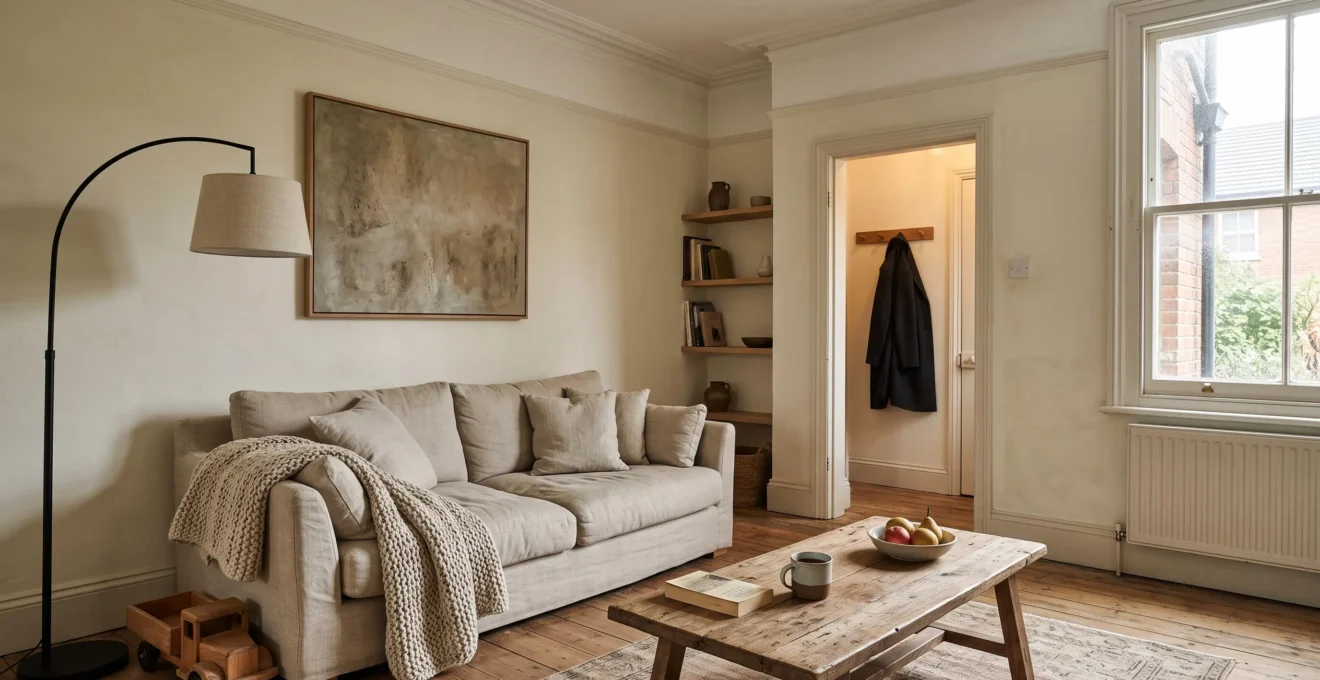
Minimalist interior design feels calm without becoming empty when it reduces unnecessary visual distractions while preserving everything that makes a home comfortable, useful and recognisably personal. The aim is not to own as little as possible. It is to create a thoughtful balance between open space, practical storage, familiar possessions, inviting materials and the activities of everyday life.
A room can contain very few objects and still feel uncomfortable. A bare sofa, exposed cables and one harsh ceiling light may look sparse without appearing peaceful. Conversely, a living room containing books, children’s belongings, comfortable furniture and a few treasured objects can feel remarkably restrained when those elements have clear places and work together visually.
The most useful approach begins with how the household actually lives. What needs to remain within reach? Which surfaces are constantly occupied? Where does natural light fall? Which belongings genuinely contribute to comfort or identity? Answering these questions makes minimalism a practical design method rather than an exercise in removing possessions.
How to create a calm minimalist home that still feels lived in
- Reduce competing colours, exposed storage and visual distractions rather than simply removing more belongings.
- Keep everyday essentials accessible, using furniture and storage systems that make tidying straightforward.
- Introduce warmth through comfortable seating, textured fabrics, layered lighting and a small number of meaningful personal details.
- Why Can a Decluttered Room Still Fail to Look Minimalist?
- How Can You Build a Minimalist Living Room Without Removing Everyday Essentials?
- Warm or Cool Minimalism: Which Works Better in a Typical British Home?
- Which Minimalist Decorating Choices Can Make a Home Harder to Live In?
- How Can You Make a Minimalist Room Feel Finished Without Adding Clutter?
- How Can You Soften Straight-Lined Furniture With Fabric, Lighting and Curves?
- When Does Simplifying a Room Start to Reduce Everyday Comfort?
- How Can Functional Simplicity Make a Busy Home Easier to Use Every Day?
Why Can a Decluttered Room Still Fail to Look Minimalist?
A decluttered room can still look visually busy because physical clutter and visual clutter are different problems. Removing unnecessary possessions reduces the number of objects, but strong colour contrasts, exposed cables, conflicting furniture styles, patterned fabrics and inconsistent storage can continue competing for attention. A calm minimalist interior needs visual coherence as well as fewer belongings.
Imagine two sitting rooms containing the same number of objects. One has a neutral sofa, a coordinating rug, concealed cables and a closed cupboard. The other has contrasting furniture finishes, brightly patterned cushions, multiple small shelves and visible electronics. Even with identical object counts, the second room may feel substantially more visually complicated.
This distinction is consistent with the broader principle illustrated by PLOS Biology research on visual clutter. In controlled perception experiments, competing stimuli affected the accuracy of visual judgments. The research did not investigate interior design or establish that minimalist homes improve wellbeing, but it demonstrates that competing visual information can matter independently of the mere presence of objects.
A practical starting point is a doorway assessment. Stand where the room is first seen and identify the visual elements attracting attention:
- The dominant wall and floor colours.
- The shapes, materials and finishes of larger furniture.
- The number of contrasting patterns and decorative accents.
- Visible small objects, cables and open storage.
- Lighting fixtures and unusually bright or dark areas.
As a working design exercise, try organising the composition around three or four coherent visual layers rather than several unrelated focal points. This is a heuristic, not a scientifically established threshold. The layers can contain multiple useful objects provided they appear visually connected.
Also consider what happens after tidying. Transferring everything into a cupboard may clear the room temporarily, but an overfilled drawer without an organising system simply relocates the problem. When belongings are difficult to retrieve and return, clutter eventually reappears.
Removing too much introduces another difficulty. A room without comfortable seating, useful surfaces or signs of personal life can appear abandoned rather than intentional.
Once the room’s competing visual elements are understood, the next priority is preserving its essential functions while making those functions less visually intrusive.
How Can You Build a Minimalist Living Room Without Removing Everyday Essentials?
A functional minimalist living room keeps frequently used belongings within easy reach while limiting how many remain visible. The best storage reduces effort rather than creating it. Remote controls, chargers, reading glasses, blankets and children’s toys can all remain part of everyday life, provided each has an obvious, convenient home close to where it is needed.
Begin by separating living room belongings into three practical categories: keep, store and hide. These categories describe how an item should be managed, not whether it deserves to remain in the home.
| Approach | Suitable belongings | Everyday arrangement |
|---|---|---|
| Keep accessible | Remote controls, reading glasses, current books | A shallow tray or accessible side-table drawer |
| Store nearby | Blankets, children’s toys, board games | An ottoman, low cupboard or labelled basket |
| Hide from view | Spare cables, occasional electronics, rarely used accessories | Closed compartments with simple internal organisation |
Furniture can perform several jobs without looking complicated. A coffee table with drawers provides an unobtrusive home for small essentials. A low sideboard offers substantial storage while creating one continuous visual line. An upholstered ottoman can provide additional seating, a place to rest feet and concealed storage.
The trade-off is accessibility. If watching television requires opening a cupboard, removing a decorative box and sorting through several compartments, the arrangement is likely to become frustrating. A system should work on a tired weekday evening, not just when the room has been prepared for photographs.
A British family home combining storage and character
A Houzz UK tour of a storage-focused family home documents a project in Ilkley, West Yorkshire. The four-bedroom midcentury house contains a 44-square-metre open-plan area designed for a couple and their two children.
Designer Heather Kealey combined practical storage and durable surfaces with colour, lighting and texture to support a calm but sociable family environment. The project illustrates how restrained design can accommodate daily use, although it does not provide measured evidence of long-term improvements in tidying time or wellbeing.
Another effective technique is a household surface rule. Rather than requiring tables and sideboards to remain completely bare, agree which objects may live on them permanently. A coffee table might hold one tray for controls and one current book, while the remainder stays available for drinks or activities.
The exact limit should reflect how the room is used. A family with young children will need a different arrangement from someone who lives alone and rarely entertains.
Five steps to organise a minimalist living room
- Identify the ten belongings used most frequently and write a short essentials inventory.
- Assign each item a keep, store or hide category and create a simple placement list.
- Choose a designated storage location within easy reach of normal use and produce an annotated room sketch.
- Set an agreed limit for permanently displayed objects on each main surface and record the surface rules.
- Use the room normally for several evenings, then note three recurring storage frustrations and the changes needed to resolve them.
With essential belongings properly accommodated, colour and lighting become the next decisions that determine whether a restrained room feels welcoming or cold.
Warm or Cool Minimalism: Which Works Better in a Typical British Home?
Warm minimalism is often the more forgiving choice in smaller or less brightly lit British homes, particularly during darker winter months. Warm whites, soft neutrals, natural wood and textured fabrics can make restrained interiors feel welcoming. Cool minimalism can work equally well, but its success depends heavily on daylight, room proportions, existing materials and carefully planned artificial lighting.
Many British properties contain features that complicate a purely cool palette: relatively compact rooms, smaller windows, fireplaces, dark flooring, traditional joinery or period architectural details. These are not disadvantages, but they should influence colour choices.
A north-facing sitting room, for example, may make a cool grey wall appear more austere than the same colour would in a bright, south-facing space. A warmer neutral can counter that impression without turning the entire room beige.
Cool minimalism is often easier to use in large rooms with generous daylight, crisp architectural lines and a limited number of materials. Pale grey, white, stone and darker accents can create an orderly appearance, provided sufficient texture and comfort remain.
The following comparison can help clarify which direction suits the space.
| Design consideration | Warm minimalism | Cool minimalism |
|---|---|---|
| Typical palette | Ivory, oatmeal, taupe, warm white | Cool white, pale grey, charcoal, slate |
| Material emphasis | Oak, linen, wool, textured ceramics | Stone, glass, metal, smooth finishes |
| Potential advantage | Inviting appearance in modestly lit rooms | Crisp, architectural appearance in bright rooms |
| Main design risk | Looking flat without tonal contrast | Feeling stark where daylight is limited |
| Useful adjustment | Introduce darker accents and varied textures | Add tactile fabrics and more localised lighting |
Paint colour should always be assessed in the actual room. Apply sufficiently large samples to the relevant walls and examine them in morning, afternoon and evening light. A colour seen on a screen or under showroom lighting may appear noticeably different beside the home’s existing flooring and furnishings.
There is also no requirement to select a single temperature for the entire property. Warm-cool zoning can provide a practical compromise. Kitchens and hallways might use cooler, simpler finishes, while living rooms and bedrooms introduce warmer textiles and softer colour transitions.
Consistency can come from repeating materials or maintaining similar levels of colour saturation rather than matching every wall.
The aim is not to select the supposedly correct minimalist palette, but to choose one that supports the comfort and atmosphere of the particular home.
Which Minimalist Decorating Choices Can Make a Home Harder to Live In?
Minimalist decorating becomes impractical when visual simplicity takes priority over ordinary household needs. Delicate white upholstery, difficult-to-maintain open shelving, insufficient lighting, uncomfortable statement furniture and a lack of convenient surfaces can all create unnecessary work. A successful minimalist home should make daily activities easier, not require constant vigilance to preserve its appearance.
Some design decisions photograph beautifully but perform poorly under ordinary conditions. A pale rug may appear elegant until muddy shoes, pets or children’s activities make frequent cleaning unavoidable. An open shelving arrangement can look carefully composed while demanding repeated dusting and rearranging.
A single statement pendant may provide an attractive centrepiece but leave a reading chair poorly illuminated. Similarly, a sculptural sofa with a narrow seat or rigid back can undermine the purpose of a room intended for relaxation.
Small functional omissions are particularly revealing. A living room without a suitable place to put down a cup of tea might appear visually pure, yet quickly becomes inconvenient for residents and guests.
These problems share a common cause: the design has been evaluated as a static image instead of an inhabited space.
Before buying furniture or making a significant layout change, conduct a simple week-in-the-life assessment. Imagine the room during ordinary and demanding situations:
- A wet weekday evening when coats, shoes and bags arrive together.
- A family afternoon when several activities occupy the room.
- A spilled drink that needs to be cleaned quickly.
- A quiet evening requiring comfortable seating and suitable reading light.
- A short tidying session before unexpected visitors arrive.
This exercise is a practical design test rather than a validated research procedure. Its value lies in exposing avoidable inconveniences before they become permanent features.
It also helps distinguish genuine clutter from signs of use. A coat on its designated hook is not necessarily a failure of minimalism. Neither is a current book beside a chair or fruit in a bowl.
Such objects can communicate where activities happen and make the home feel inhabited. They become problematic mainly when they obstruct movement, lack a permanent home or accumulate beyond what the household can comfortably manage.
The more sustainable approach is to eliminate unnecessary maintenance while retaining familiar, useful details. Those details also provide a foundation for finishing the room without overcrowding it.
How Can You Make a Minimalist Room Feel Finished Without Adding Clutter?
A minimalist room feels finished when its materials, lighting, proportions and selected personal details create a coherent atmosphere. Additional decoration is not always necessary. Texture contrast, a carefully positioned lamp, one substantial artwork and intentional areas of empty space can provide visual richness while preserving the restraint that makes minimalist design appealing.
Start with elements that contribute to the room’s atmosphere without increasing the number of separate objects. A linen sofa against a smooth painted wall offers subtle texture contrast. A wool throw adds warmth and practical comfort. Natural wood introduces visible grain, helping neutral interiors avoid looking uniformly flat.
These combinations are particularly useful when the colour palette is narrow. Two similarly coloured materials can still look distinct because they reflect light differently and have contrasting textures.
Lighting is equally important. An evenly bright room may feel functional but lack intimacy. A dimmable general light supported by a floor lamp beside the seating area can create different settings for conversation, reading and relaxation.
The U.S. Department of Energy guidance on lighting fixtures recommends combining task lighting with lower levels of ambient overhead illumination where practical. Although intended primarily for federal equipment purchasing and lighting efficiency, this principle is relevant when planning the functional lighting of a living room.
Scale also matters. One large painting can create a clearer focal point than several small frames scattered across a wall. A single handmade ceramic object, inherited photograph or personally meaningful sculpture may contribute more character than an assortment of fashionable accessories.
This is a question of intentional selection rather than buying expensive objects. The value of a personal possession comes from its significance and suitability for the space, not its price.
Negative space is part of the composition. An empty section of wall allows artwork to stand out. An uncluttered part of a shelf creates separation between displayed objects. Clear floor space improves movement and makes furniture arrangements easier to understand.
Houseplants can also introduce colour, irregular shapes and a sense of life without demanding a large collection of accessories. A carefully positioned plant may be enough to make a quiet corner feel less severe.
Research described by the Royal Horticultural Society found that participants generally viewed healthy, leafy plants with rounded forms positively in assessments of appearance and wellbeing-related qualities. This concerns perceptions of plant images rather than proven reductions in household stress.
A room feels complete when each addition improves its atmosphere or usefulness. If further decoration only fills an empty area, leaving that area untouched may be the more successful choice.
How Can You Soften Straight-Lined Furniture With Fabric, Lighting and Curves?
Straight-lined minimalist furniture can feel softer when combined with tactile upholstery, gently curved forms and lighting positioned at different heights. The underlying furniture does not necessarily need replacing. A textured sofa covering, generous curtains, a rounded table and a well-placed reading lamp can change how rigid shapes are perceived while keeping the composition simple.
Minimalist interiors frequently rely on rectangular sofas, low cabinets, slim shelving and geometrically simple tables. These forms support visual order, but when every edge is angular and every surface is smooth, the result can appear severe.
Introducing curves creates a useful contrast. An oval coffee table can interrupt the straight lines of a sofa and sideboard. An arched floor lamp can add a softer silhouette against a rectangular wall. A chair with rounded arms provides a comfortable visual transition between more angular pieces.
It is rarely necessary to introduce several curved statement objects. One carefully chosen form can establish the contrast needed.
Fabric changes the impression of furniture just as significantly. Consider a box-shaped sofa upholstered in two different materials. A smooth, pale leather finish may emphasise its precise geometry, while slubby linen and loosely arranged cushions can make a similar silhouette appear more relaxed.
Textiles are particularly effective because they serve practical purposes. A rug can make the seating area more comfortable underfoot. Full-length curtains introduce softness around windows and provide privacy. A wool throw can be used rather than existing purely as decoration.
Lighting offers another adjustment without requiring major purchases. A strong overhead source may cast pronounced shadows across angular furniture, while several appropriately positioned lights can create more gradual changes in brightness.
For a simple starting arrangement, combine general illumination with a reading lamp near the sofa. If the room includes artwork or a darker corner, a discreet accent light may be useful, but it should support a genuine need rather than add unnecessary equipment.
There is a risk of overcorrecting. Introducing multiple rugs, excessive cushions, several throws and numerous decorative lamps can replace hard-edged visual clutter with soft-edged visual clutter.
A restrained arrangement might rely on one rug, one window treatment and two or three complementary textile layers. These are illustrative design choices, not fixed requirements; the appropriate combination depends on the room and household.
The objective is to soften the experience of the room without compromising its clarity. Comfort, however, also depends on whether the room continues to support the activities for which it was designed.
When Does Simplifying a Room Start to Reduce Everyday Comfort?
Simplifying a room has gone too far when ordinary activities become more difficult, seating becomes less comfortable or essential belongings are no longer conveniently accessible. If residents repeatedly search for everyday objects, avoid using certain furniture or move their possessions elsewhere, the room may have crossed its practical comfort threshold, even if it looks beautifully restrained.
The warning signs are often small rather than dramatic. Someone may begin leaving their reading glasses in another room because no suitable drawer remains beside the sofa. A family might avoid gathering in the living room because the new seating is uncomfortable. Children may carry their toys elsewhere because the storage arrangement is too complicated.
These behaviours deserve attention. They indicate that the design is no longer aligned with the life taking place inside it.
There is no universal ideal number of possessions. A couple who spend most of the day away from home may need relatively few items within reach. A family of five dealing with schoolwork, hobbies, pets and shared leisure activities is likely to require more accessible storage, durable furniture and flexible surfaces.
Both homes can be minimalist. Their appropriate levels of visible belongings and storage capacity will simply differ.
The psychological atmosphere matters too. If everyone is afraid to touch a cushion, place a drink on a table or leave a book unfinished, the room may feel more like a showroom than a home.
Visual restraint should reduce unnecessary demands on attention, not introduce new household rules that create tension.
When simplification begins causing difficulties, there is usually no need to redesign everything. A targeted correction can be more effective:
- Identify the three most frequent frustrations experienced in the room.
- Determine whether each problem involves accessibility, comfort, lighting or insufficient surface space.
- Restore the smallest useful piece of furniture, storage feature or everyday object that directly resolves the problem.
- Observe whether the change improves ordinary use without producing avoidable clutter.
For example, adding a compact side table beside a favourite chair may solve several problems at once. It provides space for a drink, a current book and reading glasses without substantially changing the room’s visual character.
Accepting a modest increase in visible objects can be a sensible trade-off when the alternative is repeated inconvenience.
A genuinely comfortable minimalist room is not one that never changes. It is one that can adapt to its residents while remaining straightforward to use and maintain.
Key takeaways for maintaining a comfortable minimalist home
- Preserve the storage, seating and surfaces required by real household routines, even when that means keeping more possessions than a styled photograph suggests.
- Judge every organisational decision by accessibility and ease of maintenance, not appearance alone.
- Build simple daily reset habits into the layout so the home can return to a calm state without demanding constant tidying.
How Can Functional Simplicity Make a Busy Home Easier to Use Every Day?
Functional simplicity makes a busy home easier to manage by giving frequently used belongings obvious places, keeping essential routes clear and reducing the effort required to tidy. Rather than treating minimalism purely as a visual style, the household uses it as a straightforward organisational system. The result is a home that can accommodate daily activity without requiring constant rearrangement.
Busy homes rarely remain perfectly tidy throughout the day. School bags arrive, shoes are removed, post accumulates, activities change and belongings move between rooms. A useful minimalist arrangement anticipates these patterns instead of expecting residents to avoid them.
One of the most practical places to begin is the entrance. Without a designated drop zone, keys, coats, shoes and bags tend to spread across whichever surfaces are most convenient.
A functional entrance can include wall hooks at accessible heights, a tray for keys, a place for incoming post, a shoe mat and a basket or compartment for each household member.
These elements need not be expensive or visually complicated. Their purpose is to make the correct action easier than leaving something in the wrong place.
This same principle can be repeated elsewhere. Keep frequently used cooking utensils near the preparation area. Place laundry baskets where clothes are normally removed. Give children’s toys storage they can reach independently, using compartments that are simple enough for them to understand.
The objective is to reduce the number of small decisions required to put the house back in order.
Another useful consideration is reset speed: how easily can a room return to a comfortable, orderly state after normal use?
A living room with closed storage, accessible baskets and clearly assigned surfaces may be easier to reset than one with several delicate displays and no convenient place for ordinary belongings. The exact time required will vary, so the aim is not an invented universal target but a process that feels manageable to the household.
Where appropriate, duplicate inexpensive organisational essentials rather than making residents share one inconvenient location. A basket per person or a hook for each regularly used coat may prevent a recurring bottleneck.
Simple routines can reinforce the layout. Returning items to their designated places at the end of an activity is often easier than postponing everything until a major weekly tidy. However, the system should remain flexible enough to accommodate visitors, new hobbies and changes in family life.
Minimalism becomes particularly effective when it removes unnecessary obstacles without restricting personal expression. A book left beside a chair, a child’s favourite toy or a framed family photograph can remain visible when those details are meaningful and do not interfere with everyday use.
Functional simplicity therefore connects directly to the emotional goal of interior minimalism: creating a setting in which the household feels comfortable living, rather than carefully preserving an idealised appearance.
Start with one room that causes repeated frustration. Identify the objects used there most often, assign them convenient places and remove only what interferes with the room’s purpose. Then assess the result during ordinary daily life. A minimalist home feels calm without becoming empty when its simplicity supports the people living in it.
Can a minimalist home include family photographs and sentimental objects?
Yes. Minimalism does not require removing personal possessions. A small selection of meaningful photographs, inherited objects or handmade pieces can make a restrained home feel distinctive. Grouping related items, choosing a consistent display area and leaving surrounding space uncluttered helps them stand out without making the room visually busy.
Do minimalist interiors have to be white or beige?
No. Minimalism depends more on deliberate selection and visual coherence than on any specific colour. Muted greens, earthy browns, soft blues and darker colours can work well when the palette is controlled and balanced with suitable lighting and materials. Stronger colours are also possible when used intentionally rather than competing across numerous unrelated elements.
How can renters create a warmer minimalist interior without renovating?
Focus on reversible changes such as textured cushions, washable rugs, freestanding lamps, curtains and movable closed storage. Rearranging furniture to improve circulation can also make a room feel calmer without permanent alterations. Choose changes compatible with the tenancy agreement, particularly where fixing items to walls or replacing existing fittings is concerned.
Is closed storage always better than open shelving for minimalism?
No. Closed storage is useful for visually varied belongings, such as chargers, toys and paperwork, while open shelving works well for selected books, frequently used items and meaningful objects. The best arrangement depends on accessibility, maintenance and the number of items displayed. A combination of open and closed storage is often more practical than relying exclusively on either type.
What should be changed first when a minimalist room feels cold?
Assess lighting and texture before purchasing more decoration. Try a suitable localised lamp, a tactile throw or a warmer fabric near the principal seating area. Next, examine the room’s colour temperature and whether its materials feel overly uniform. Often a small adjustment to existing elements makes a greater difference than introducing several new accessories.