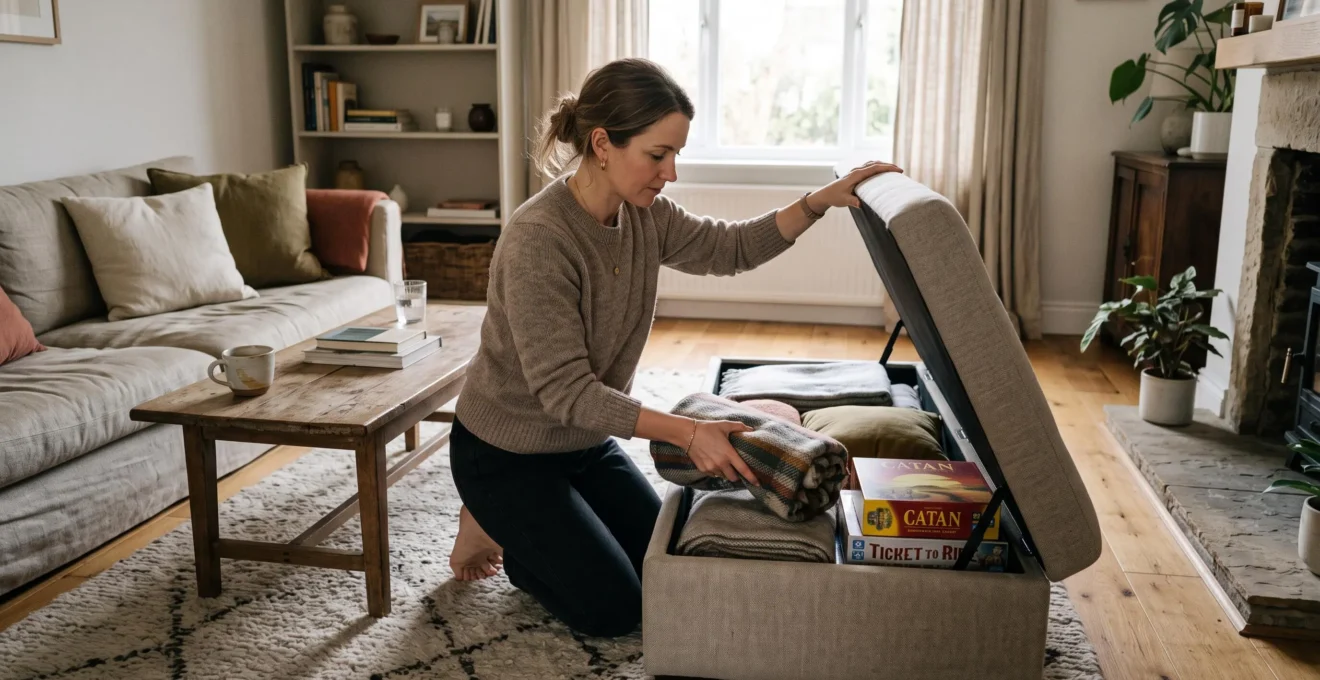
Hidden storage can make a busy room feel calmer without forcing everyday essentials out of reach. The principle is straightforward: keep necessary belongings behind doors, inside drawers or beneath multifunctional furniture, but place them close enough to where they are used that putting them away remains convenient.
The challenge is not simply finding more storage capacity. A deep cupboard may conceal dozens of items while making daily routines more frustrating. A compact drawer beside the sofa, by contrast, may provide less space but work far better for frequently used belongings.
Effective concealed storage therefore balances three requirements: fewer objects competing for visual attention, easy retrieval and enough usable floor space for normal activities. It also requires decisions about what deserves to stay, rather than automatically finding somewhere to hide everything.
From storage benches and beds to built-in cabinetry and task-based organization, the most useful solutions are those that fit real household habits. The aim is a room that looks composed and can return to that state without a complicated tidying routine.
Hidden storage that works in everyday life
- Reduce visual clutter: Conceal distracting objects while keeping intentionally displayed pieces visible.
- Match accessibility to frequency: Give daily essentials the easiest storage positions and reserve deeper compartments for occasional belongings.
- Organize around activities: Put concealed storage near where items are actually used, with clear categories and realistic capacity limits.
- Why Does Hidden Storage Make a Room Feel Less Cluttered Even When Nothing Is Removed?
- How Can You Add Hidden Storage Under Seating, Beds and Benches?
- Built-In or Freestanding Hidden Storage: Which Is Better for Your Home?
- What Makes Hidden Storage Turn Into Unmanageable Clutter?
- What Should You Hide First When a Living Room Feels Cluttered?
- Why Does Hard-to-Reach Storage Lead to More Everyday Clutter?
- How Can You Simplify a Room Around the Tasks You Perform Every Day?
- How Can Functional Simplicity Make a Busy Home Easier to Use Every Day?
Why Does Hidden Storage Make a Room Feel Less Cluttered Even When Nothing Is Removed?
Hidden storage makes a room feel less cluttered because it reduces the number of objects competing for visual attention. When everyday belongings disappear behind cabinet doors or inside furniture, surfaces become easier to read as a unified space. The total quantity of possessions may remain unchanged, but the visible environment becomes simpler.
A room containing books, chargers, toys, spare blankets and electronic accessories may have perfectly usable furniture yet still appear busy. Each exposed object introduces another shape, colour, edge or texture. Concealing selected items reduces this visual complexity without requiring a major renovation or a complete reduction in possessions.
Scientific research helps explain the distinction. The research published in Journal of Vision on measuring visual clutter, by Ruth Rosenholtz, Yuanzhen Li and Lisa Nakano in 2007, examines how excessive or disorganized visual elements can interfere with recognition and visual search.
That study did not test residential hidden storage or establish how many household objects must be concealed to improve a room’s appearance. Nevertheless, its findings about visual processing provide a relevant explanation for why reducing exposed detail can make a space easier to visually interpret.
Visual decluttering and reducing possessions are different goals. Decluttering through sorting lowers the amount of property that must be managed. Concealed storage primarily changes what remains visible. Both can be useful, but one does not automatically accomplish the other.
A simple before-and-after photography exercise can help evaluate the visual effect:
- Photograph the room from its main entrance, keeping the camera position consistent.
- Identify and count separately visible loose objects on prominent surfaces.
- Move a small selection of nonessential visible items into appropriate concealed locations.
- Take another photograph from the same position and compare the overall impression.
This is a practical self-assessment, not a scientifically validated measurement. It helps reveal which objects contribute most to the room’s apparent busyness.
A table holding several remote controls, a charging cable, unopened mail and spare coasters may look considerably calmer when only the objects needed at that moment remain visible. The same principle applies to open shelving, bedside tables and kitchen counters.
Concealment offers a relatively immediate visual improvement, but lasting organization still depends on knowing what is stored, whether it is needed and how easily it can be retrieved.
How Can You Add Hidden Storage Under Seating, Beds and Benches?
Hidden storage can be added beneath seating, beds and benches through lift-up compartments, integrated drawers or removable containers in open recesses. Each arrangement uses space that furniture already occupies, but accessibility differs. Drawers often suit regularly needed belongings, while deeper compartments are generally more appropriate for items retrieved occasionally.
Multifunctional furniture is especially useful where adding another cabinet would restrict movement. A storage ottoman can hold blankets or games without occupying additional floor space beyond its seating or footrest function. A hallway bench can accommodate accessories while still providing somewhere to sit when putting on shoes.
Three common configurations offer different advantages:
- Lift-up storage: Hinged lids on ottomans, benches or storage beds can reveal relatively large compartments. However, access may require clearing the top surface or lifting a substantial panel.
- Integrated drawers: Drawers allow contents to be divided into categories and accessed without exposing an entire storage cavity. They require sufficient clearance to open fully.
- Open recesses with removable bins: Bins can be moved or rearranged independently, making them useful for occasional belongings. The recess may still expose container fronts and collect dust.
The following comparison helps match each arrangement to actual retrieval habits rather than appearance alone.
| Storage method | Suitable contents | Main practical consideration |
|---|---|---|
| Integrated drawers | Weekly-use textiles, accessories, toys or spare bedding | Enough unobstructed space to pull the drawers out |
| Lift-up compartment | Throws, board games or other items used occasionally | Lid weight, opening angle and safe lifting mechanism |
| Recess with removable bins | Seasonal clothing and less frequently needed belongings | Dust protection and room to remove containers |
These are practical starting points rather than universal rules. A well-designed lift-up ottoman may be convenient for weekly use, while a drawer blocked by nearby furniture can be frustrating even when its contents are neatly organized.
Manufacturer documentation illustrates one possible arrangement. IKEA’s SLÄKT underbed product documentation describes a configuration combining an underbed sleeping arrangement with two drawers intended to accommodate belongings such as bedlinen and toys. This establishes the specific product’s functions, not the comparative convenience of all under-bed storage systems.
Before choosing a storage bed, check the mattress height, available walking space, drawer dimensions and whether nearby furniture will interfere with opening. For lift-up mechanisms, consider the quality and suitability of hinges or assisted lifting components, following the manufacturer’s instructions.
Storage benches also deserve careful placement. A bench used beside an entrance might hold shoe-care supplies or seasonal accessories, but daily keys are better kept in a smaller, more accessible location.
Start with an inventory of objects requiring storage, recording how often each is needed. Then select furniture around those requirements instead of purchasing a storage piece first and deciding what to put inside afterward.
Once the access method is clear, the next decision is whether concealed storage should be permanently integrated into the room or remain movable as needs change.
Built-In or Freestanding Hidden Storage: Which Is Better for Your Home?
Built-in hidden storage is generally preferable when a room contains awkward spaces that standard furniture cannot use efficiently, or when long-term integration is a priority. Freestanding storage is often more suitable for renters, changing households and flexible room layouts because it can be moved, replaced or reconfigured without permanent alterations.
The choice depends less on which option looks more sophisticated and more on how the room will be used over time.
Built-in cupboards can follow sloping ceilings, fill alcoves or incorporate storage beneath stairs. This makes them worth considering when conventional cabinets would leave substantial unused gaps. Flush door fronts can also create an uninterrupted visual surface that blends with surrounding walls.
However, fitted storage usually involves more planning, installation work and site-specific expense. It may remain behind when the household moves, and its internal arrangement can become unsuitable as belongings or routines change.
Freestanding cabinets with solid doors, drawer chests and concealed-storage benches offer a different advantage. They can be positioned near everyday activities, relocated between rooms and replaced independently when requirements change.
| Decision factor | Built-in storage | Freestanding storage |
|---|---|---|
| Upfront investment | Often higher due to fitting and installation | Often lower with standard furniture |
| Irregular room geometry | Can be tailored to recesses and sloped surfaces | Limited by available furniture dimensions |
| Relocation | Generally permanent | Usually movable |
| Changing storage requirements | May require internal modifications | Pieces can be rearranged or replaced |
| Visual integration | Can align closely with walls and architectural details | Depends on furniture proportions and finish |
These comparisons describe typical design trade-offs, not verified cost or performance rankings. Actual expense depends on dimensions, materials, installation requirements and local conditions.
For renters or households expecting to move, freestanding solutions generally reduce the risk of investing in storage that cannot travel with them. Homeowners planning to remain in a difficult-to-furnish property may place greater value on fitted cabinetry.
A hybrid approach can offer useful flexibility. One built-in cupboard might accommodate bulky supplies in an alcove, while a movable storage ottoman holds throws and games close to the seating area.
This arrangement separates long-term capacity from everyday access. The permanent component handles objects that need a stable home; the movable pieces respond to changing routines.
Before committing to cabinetry, mark out the proposed footprint and check door swings, walking paths and the positions where users will stand when accessing contents. A beautiful installation that obstructs circulation is unlikely to improve everyday convenience.
Regardless of furniture type, keeping belongings behind closed fronts works only if the concealed space has a clear purpose and does not become an unrestricted collection area.
What Makes Hidden Storage Turn Into Unmanageable Clutter?
Hidden storage becomes unmanageable when compartments collect unrelated objects without categories, quantity limits or regular review. Because their contents are no longer visible, households may forget what they already own, struggle to retrieve specific belongings or keep adding possessions without reconsidering what is necessary. Concealment then disguises disorder rather than resolving it.
A deep bench compartment illustrates the problem. Initially, it may hold blankets and board games. Over time, unused chargers, paperwork, toys and miscellaneous accessories get added because the lid hides them immediately.
Eventually, retrieving a blanket requires moving several unrelated objects. The compartment still looks tidy from outside, but its internal organization no longer supports the household.
Grouping belongings is a more reliable starting point than purchasing extra containers. The University of Georgia Cooperative Extension’s household clutter guidance recommends sorting possessions, grouping similar items and establishing organized locations for different categories.
That guidance supports a practical principle: decide what belongs in a space before choosing how to contain it. It does not establish that concealed compartments inevitably cause forgotten possessions or duplicate purchases, but those are reasonable risks to consider when storage is difficult to inspect.
A straightforward zoning approach can help:
- Assign each concealed compartment one primary category, such as spare bedding, games or electronic accessories.
- Keep related objects together using dividers or containers only where they make retrieval easier.
- Set a practical capacity limit based on how much can be stored without obstructing access.
- Review the compartment when that limit is reached instead of immediately adding another box.
- Relocate or remove objects that no longer belong to its intended category.
Quantity limits need not be arbitrary numerical quotas. A useful limit might simply be that every game can be removed without dismantling a pile, or that drawer contents remain visible when the drawer opens.
The container trap occurs when storage purchases substitute for decisions about possessions. More boxes may provide temporary structure, but they also occupy space and can make overfilled cupboards more complicated.
Editing should therefore precede additional storage investment. Sort out objects that are unused, duplicated, damaged or better kept elsewhere, then choose containers for what remains.
Once concealed spaces have defined purposes, deciding which visible belongings should enter them becomes easier and more selective.
What Should You Hide First When a Living Room Feels Cluttered?
When a living room feels cluttered, conceal visually distracting objects that are not needed constantly, particularly loose media accessories, spare chargers, extra throws and occasional toys. Keep frequently handled essentials close to their point of use, and remove belongings that should be stored elsewhere. Prioritize visibility, frequency of use and the effort required to put each item away.
Start by standing at the room’s main entrance rather than examining individual cupboards. The entrance view reveals which exposed objects dominate the overall impression.
A tangled group of cables beside a television, an overflowing basket of toys or several folded blankets stacked on a chair may attract attention before larger furniture does. These are sensible candidates for concealment if they are still useful.
Not every visible object should disappear. Books that are actively being read, a chosen artwork or a decorative object can contribute to the room’s character. The objective is to remove accidental visual competition, not eliminate personality.
Use four decisions when assessing each item:
- Hide: Keep necessary but visually distracting belongings in an accessible concealed compartment.
- Relocate: Return objects to the room where they are primarily used.
- Discard or pass on: Remove possessions that are no longer wanted or useful, using suitable disposal or donation routes.
- Deliberately display: Retain selected objects that contribute to the room’s appearance or are intentionally kept visible.
Consider a living room where a sofa is surrounded by children’s toys, media remotes, chargers and throws. Toy overflow might belong in a nearby storage bench, spare cables in a dedicated drawer and extra blankets inside an ottoman.
Frequently handled remotes are different. Placing them inside a deep cupboard across the room makes each use unnecessarily inconvenient. A shallow drawer or small concealed compartment beside the usual seat provides a more realistic solution.
A five-step living room concealment checklist
- Photograph the room from its main entrance and save one clear reference image.
- Identify the five most visually distracting groups of objects and record them on a short priority list.
- Mark each group as hide, relocate, discard or display, creating a decision beside every entry.
- Choose a storage location for each group marked hide, noting how often the contents are needed.
- Test putting the objects away and retrieving them, then take a comparison photograph and record any inconvenient storage locations.
For example, spare throws that are used occasionally may be well suited to a lift-up bench, while reading glasses need a reliably accessible position beside the chair where they are worn.
Concealment should also preserve safe charging arrangements and ventilation around electronics. Electrical devices should not be covered, enclosed or operated in storage locations contrary to their manufacturer’s instructions.
The result should be a more composed room without forcing household members to search for items they use every day. That balance depends heavily on how much effort each storage location requires.
Why Does Hard-to-Reach Storage Lead to More Everyday Clutter?
Hard-to-reach storage encourages visible clutter because retrieving and replacing belongings becomes inconvenient. When an item can only be put away after opening several doors, shifting containers or bending into an awkward space, leaving it nearby may feel easier. Frequent use then gradually moves belongings back onto tables, chairs and countertops.
This is a problem of access friction: the physical and practical effort separating an object from its intended storage location.
Imagine keeping a frequently used laptop charger in a box at the back of a low cupboard. To reach it, someone must open the cupboard, remove another container and search inside the box. After repeating those actions throughout the day, leaving the charger on a nearby surface becomes an understandable shortcut.
The same pattern can occur with toys stored under heavy furniture, kitchen tools placed behind rarely used equipment or blankets that require lifting a bed platform every evening.
Even small obstacles can make an organization system less appealing. However, no supplied research establishes that one additional action necessarily causes a storage habit to fail. The useful design principle is to identify repeated inconvenience rather than assume a universal threshold.
Accessibility guidance offers a relevant perspective. Guy’s and St Thomas’ NHS Foundation Trust advises keeping frequently used belongings within comfortable reach when explaining how to manage everyday tasks using one hand. Its specific recommendations were developed for people with particular physical limitations, not as universal household storage measurements.
The most frequently used belongings should occupy the easiest accessible positions. Less frequently needed objects can tolerate the inconvenience of deeper cupboards, higher shelves or storage beneath furniture.
A friction audit can reveal whether the current arrangement supports this priority. Choose an object, retrieve it from its usual location, use it briefly and put it away again. Notice whether either movement feels awkward, requires moving obstacles or interrupts the activity.
Timing the retrieval and replacement process can make differences easier to notice, but the stopwatch should be used as a personal comparison tool, not a pass-or-fail test based on an invented number of seconds.
If the process feels unnecessarily effortful, consider moving the object into a shallower drawer, placing its container nearer the front or reducing the number of barriers involved.
Storage should also respect the physical abilities of the people using it. Heavy objects, awkward lifting motions and obstructed passageways deserve particular attention, even when a storage solution looks visually discreet.
Reducing access friction becomes even more effective when storage positions are planned around the activities that actually happen in each part of the home.
How Can You Simplify a Room Around the Tasks You Perform Every Day?
You can simplify a room by identifying the activities performed there and placing the necessary objects and concealed storage close to each activity. Instead of organizing everything solely by object category, create practical task zones for relaxing, working, eating or playing. Each zone should support both using belongings and returning them to storage with minimal disruption.
Traditional organization often groups similar objects together. That can work well for spare supplies, but daily items also need to be located where they are used.
For example, keeping every charging cable in one central cupboard creates a clear category, yet it may be inconvenient if devices are usually charged beside the sofa or at a desk.
A task-based approach begins with behaviour. Observe where people sit, work, read, snack, play games and leave frequently used belongings. Then identify which of these activities generates the most visible accumulation.
Consider three zones in a multifunctional living room:
- Relaxation zone: A sofa-side drawer holds remotes, reading glasses and charging accessories, while occasional blankets are stored inside an ottoman.
- Work zone: A desk drawer or nearby closed cabinet accommodates stationery, laptop accessories and documents that need to be accessible during working hours.
- Family activity zone: A low storage bench contains games and toys near the floor area where they are normally used.
These zones do not need separate walls or large furniture arrangements. They can overlap naturally, provided that each frequently used object has a convenient destination.
Design for actual routines, not idealized behaviour. A living room may be intended for relaxing but also function as a temporary homework space, a children’s play area or an occasional dining space.
Ignoring those activities leaves people without practical places to put the objects they require.
A one-week observation exercise can reveal the mismatch. Notice where belongings repeatedly accumulate, especially after busy mornings and evenings. Rather than treating every pile as a housekeeping failure, ask which activity produced it and why the nearby storage is not being used.
A pile of homework materials beside the sofa, for instance, may indicate that study regularly happens there. A shallow drawer or closed mobile organizer could serve that real behaviour better than insisting that every item return immediately to a distant desk.
Keep floor routes clear and avoid placing furniture where doors, drawers or circulation paths become obstructed. Functional zones should make movement easier, not divide a room into impractical compartments.
Once storage follows actual activities, concealed compartments stop being isolated containers and become part of a practical system that households can maintain even on busy days.
Key takeaways for a storage system that lasts
- Every frequently used item needs a convenient, predictable return location, not merely available storage capacity.
- The best concealed spaces combine clear categories with access suited to the contents’ actual frequency of use.
- Review recurring clutter as feedback about the room’s layout and routines before purchasing more furniture.
How Can Functional Simplicity Make a Busy Home Easier to Use Every Day?
Functional simplicity makes a busy home easier to use by ensuring that putting belongings away is nearly as convenient as leaving them out. It combines selective concealment, accessible storage and activity-based placement. Instead of requiring constant tidying or rigid discipline, the room supports straightforward habits that make restoring order more manageable.
A functionally simple home is not necessarily minimalist. It may contain children’s toys, work supplies, hobby equipment and everyday accessories. The difference is that these belongings have defined locations that correspond to how and where they are used.
For concealed storage to support this approach, three decisions must work together.
First, prioritize what should disappear from view. Bulky or visually distracting objects that are not constantly needed often offer useful opportunities to clear exposed surfaces.
Second, match access difficulty to retrieval frequency. A remote control might belong in a small sofa-side drawer, games in a storage ottoman and seasonal decorations in a deeper cupboard.
Third, establish drop points near recurring activities. A drop point is a designated location where frequently handled belongings can be returned without searching or reorganizing other objects.
These decisions are most successful when they form one coherent system. Concealing belongings alone does not prevent clutter if the storage is difficult to reach. Convenient drawers do not solve the problem if they contain unrelated items with no defined organization.
Maintenance matters because even well-designed systems can gradually stop matching a household’s needs.
A light periodic review can identify changes before compartments become difficult to use. Open each concealed zone and check whether the contents still belong together, whether the quantity remains manageable and whether objects used regularly have migrated back onto visible surfaces.
Reviewing storage does not require emptying every cupboard at once. One drawer, bench or cabinet at a time is enough to identify misplaced objects and adjust the arrangement.
The University of Georgia Cooperative Extension’s household organization guidance also emphasizes manageable starting areas and regular putting-away habits. Those principles can complement concealed storage without requiring a complete household overhaul.
Involve the people who share the space. A drawer that seems obvious to one person may be inconvenient or difficult to identify for another. Commonly used storage should be easy for its intended users to understand and operate safely.
When clutter repeatedly returns to the same surface, consider it information. The nearest compartment may be too full, the relevant category may be poorly defined or the return journey may be inconvenient. Correcting that obstacle is generally more useful than repeatedly clearing the surface without changing the system.
Begin with one surface that repeatedly gathers belongings. Identify what belongs there, choose an accessible concealed location for what does not, and test whether returning those items feels natural during normal daily activities. The realistic goal is not a permanently spotless home, but a space that can be reset easily after ordinary, busy days.
Can hidden storage work in a small room without adding bulky furniture?
Yes. Storage integrated into furniture already needed in the room can help preserve usable floor space. Examples include drawers beneath beds, storage benches and ottomans with internal compartments. Check the space needed to open each storage mechanism before buying, since a compact piece can still be inconvenient if its drawers or lid cannot operate freely.
Should hidden storage be labelled if the labels would spoil the appearance?
Labels can be placed inside cabinet doors, on interior dividers or on containers that remain concealed. They are particularly helpful where several household members use the same storage or where similar items occupy neighbouring compartments. Simple, consistent categories can be more useful than elaborate labelling systems.
Is it better to store belongings together by category or close to where they are used?
Use both principles according to frequency. Occasional supplies can be grouped by category in a central location, while daily essentials are generally more convenient near their usual activity zones. When keeping everything together creates repeated unnecessary trips, a smaller local storage point may improve practicality.
How can you tell when concealed storage is too full?
A concealed compartment may be too full when items must be removed to reach unrelated contents, drawers become difficult to close or the intended categories can no longer be maintained. Review the contents and remove or relocate unnecessary belongings before increasing storage capacity. The useful limit is the amount that can be stored and retrieved comfortably, not simply the maximum volume that fits.
How often should hidden storage be reviewed?
There is no universal review interval. Inspect a concealed area when it becomes difficult to use, when belongings repeatedly accumulate nearby or when household routines change. Frequently used drawers may need attention more often than seasonal storage. Short reviews of individual compartments can be easier to maintain than occasional whole-home reorganizations.