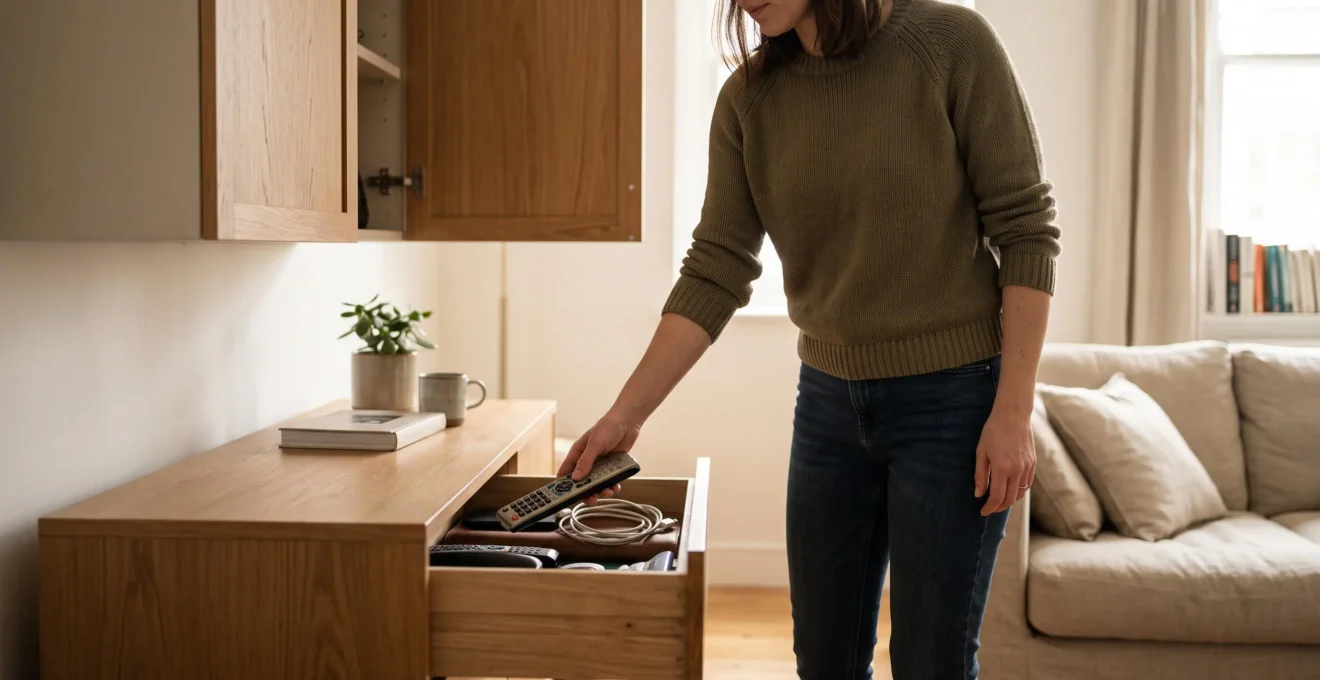
A home can have plenty of cupboards and shelves yet still feel cluttered. The problem is often not a lack of storage space but the effort required to use it. When everyday objects are kept too high, too deep or behind several obstacles, leaving them on a nearby table becomes the easier option.
Making everyday storage easier to reach starts with placing frequently used items in accessible locations and giving each one a simple place to return to. Attractive objects can remain visible, while visually messy essentials can sit in drawers or cabinets that open quickly. Items used only occasionally belong in the less convenient spaces.
This approach is particularly useful for households where cabinets are already full but worktops, coffee tables and other surfaces continue to collect belongings. Rather than immediately buying more furniture, examine how existing storage is distributed, how different family members reach it and whether putting something away feels as easy as taking it out.
Everyday storage: the essentials
- Prioritise easy returns: Keep frequently handled items within comfortable reach, without moving other belongings first.
- Control what stays visible: Display visually calm objects and give chargers, paperwork and smaller accessories accessible concealed homes.
- Reorganise before expanding: Move occasional items into awkward storage zones and reserve convenient spaces for daily routines.
- Why Does Hard-to-Reach Storage Lead to More Everyday Clutter?
- How Should You Organise Storage Around the Things You Use Every Day?
- Open Shelves or Closed Cabinets: Which Make Daily Items Easier to Manage?
- Which Storage Locations Are Too High, Deep or Awkward for Daily Use?
- What Storage Should You Reorganise First Before Adding More Cabinets?
- What Should You Hide First When a Living Room Feels Cluttered?
- How Should You Arrange Everyday and Occasional Items in Tall Storage?
- How Can Hidden Storage Reduce Clutter Without Making Everyday Items Hard to Reach?
Why Does Hard-to-Reach Storage Lead to More Everyday Clutter?
Hard-to-reach storage can encourage everyday clutter because putting an object away requires more effort than leaving it nearby. A cupboard that demands stretching, moving boxes or rearranging other belongings introduces friction into a simple task. When this happens repeatedly, convenient surfaces may become informal storage areas, even when the household has enough cabinet space.
Consider a remote control stored behind several board games in a deep cabinet. Taking it out requires opening the door and moving the games. Returning it involves the same sequence in reverse. Leaving it on the coffee table is simpler, particularly when someone expects to use it again shortly.
This difference can be described as an item’s return cost: the number of actions and obstacles involved in putting it back. It is a practical household assessment tool, not a scientifically established measurement.
To evaluate one storage location, take an everyday object and count what happens between holding it and leaving it in its assigned place. Opening an easily accessible drawer is a minor step. Lifting a lid, removing a basket and shifting other belongings creates more friction.
The consequences can extend beyond one cupboard. If a difficult cabinet discourages people from returning daily objects, those objects may accumulate on worktops, tables or chairs. These surfaces then become harder to use for their intended purposes.
The ergonomic principle behind easier placement has support in OSHA‘s workstation evaluation checklist, which recommends keeping frequently accessed items within easy reach, generally with the elbows close to the body. This guidance concerns computer workstations rather than domestic clutter, but it offers a useful reference for assessing reach.
For a family, the practical question is not whether everyone is sufficiently disciplined to tidy up. It is whether the storage arrangement makes tidying straightforward for the people who actually use it.
Once these points of friction are visible, the next step is to decide which belongings deserve the most convenient locations.
How Should You Organise Storage Around the Things You Use Every Day?
Organise household storage according to how frequently objects are used, not simply by category or available space. Place daily essentials in comfortable, easily visible locations, keep weekly items nearby and move occasional belongings into less accessible areas. When several objects compete for the same space, prioritise those whose absence would most disrupt everyday routines.
Begin with a short observation period rather than immediately rearranging the cupboards. Over one typical week, notice which objects are handled, who uses them and where they are usually needed. Record actual behaviour, including repeated searches and items left outside their assigned places.
Then divide the inventory into three practical frequency groups:
- Daily: Items such as keys, drinking glasses, commonly used cooking utensils and remote controls. Give these the shortest practical retrieval and return paths.
- Weekly: Items used regularly but not constantly, such as certain baking tools, cleaning attachments or hobby supplies. Place them adjacent to prime storage zones.
- Occasional: Seasonal decorations, spare serving dishes and rarely needed equipment. Allocate these to higher, lower or deeper storage, subject to safe handling.
For standing adults, waist-to-shoulder-height storage is often a useful starting point, but it should not become a rigid rule. Children, seated users and people with different mobility or reach requirements may need entirely different prime zones.
OSHA’s nursing-home ergonomics guidelines recommend keeping frequently used and heavy supplies on carts within easy reach between hip and shoulder height. Although the guidance concerns workplace activities rather than homes, it reinforces the value of arranging frequently handled objects within comfortable reach.
Use a one-motion rule to decide whether a storage spot deserves daily-use priority: an object should be accessible without lifting, unstacking or moving something else. A drawer or cabinet door may still need opening, provided the contents are immediately accessible.
When space is limited, compare the consequences of relocating competing items. A child’s daily school supplies may deserve a more convenient location than decorative tableware, even when the tableware is used several times a week. However, items needed urgently, including essential accessibility aids, can take priority regardless of how often they are handled.
Finally, distinguish necessary routines from habits created by poor placement. Something repeatedly left on the dining table may belong there temporarily, or it may simply lack a convenient home nearby.
After the most-used belongings have suitable locations, decide how much of that storage should remain visible.
Open Shelves or Closed Cabinets: Which Make Daily Items Easier to Manage?
Open shelves are often convenient for frequently used objects that look orderly when displayed, while closed cabinets are better suited to everyday items that create visual noise. Neither arrangement is automatically superior. The most practical solution combines easy access with the amount of visual exposure each category needs or can tolerate.
Open shelving makes items easy to identify and often removes the need to open a door. It works well for a modest selection of drinking glasses, regularly used books or matching containers. However, exposed shelves collect dust and can appear crowded when filled with small, unrelated objects.
Closed cabinets visually simplify a room, particularly when they conceal cables, paperwork, cleaning supplies or mixed accessories. Their drawback is that doors and poorly organised interiors may make returning belongings more cumbersome.
The distinction becomes clearer when frequency and appearance are considered together.
| Item characteristics | Preferred storage | Practical reason |
|---|---|---|
| Frequently used and visually calm | Open shelf or accessible hook | Easy to identify, retrieve and return without creating much visual distraction. |
| Frequently used and visually messy | Shallow drawer or accessible closed cabinet | Conceals small objects while keeping each one individually reachable. |
| Occasionally used and visually calm | Secondary open or closed storage | Does not need to occupy the most convenient daily-use space. |
| Occasionally used and visually messy | Closed storage in a secondary zone | Keeps visual clutter down without sacrificing accessible daily storage. |
| Sensitive to dust or light | Suitable protective closed storage | Protection may matter more than display convenience. |
For closed storage, internal organisation often determines whether the arrangement succeeds. Drawer dividers, shallow trays and separate compartments prevent belongings from becoming stacked or hidden. When the cabinet opens, the intended object should already be visible.
For open shelves, limit the number of categories rather than filling every available centimetre. A shelf with several everyday objects can remain practical without being visually busy, especially when each object has enough space to return easily.
The most useful arrangement is often mixed storage: a small accessible display area for visually neutral essentials, supported by nearby drawers for miscellaneous items.
Whichever option is chosen, a convenient-looking cabinet is not truly convenient if its height or depth puts its contents out of comfortable reach.
Which Storage Locations Are Too High, Deep or Awkward for Daily Use?
Storage locations are generally unsuitable for everyday objects when using them requires a stool, uncomfortable stretching, kneeling to identify contents or reaching around other belongings. Deep shelves can be equally inconvenient if frequently needed items disappear behind a front row. These spaces are better reserved for suitable occasional items or adapted to make their contents accessible.
A practical audit begins with an actual retrieval rather than a visual inspection. Choose an object stored in a questionable location and take it out as you normally would. Then return it while noticing the movements involved.
Flag locations where you must stand on tiptoes, reach above your comfortable range, bend awkwardly, move several objects or search blindly behind other belongings. The appropriate reach zone depends on the user’s height, mobility and physical abilities.
Depth deserves particular attention. A shelf may be installed at a comfortable height but still be inconvenient if its contents extend farther back than someone can comfortably reach or see.
The US Access Board‘s ADA accessibility standards illustrate how obstructions affect reach. Under certain specified forward-reach conditions, a maximum reach height of 48 inches maximum reach height (1220 mm) is reduced to 44 inches (1120 mm) when the obstruction depth exceeds 20 inches (510 mm). These are accessibility requirements for covered environments, not universal dimensions for private household cupboards.
For everyday domestic storage, the simpler test is whether the intended user can retrieve the object safely and comfortably without unnecessary repositioning.
Deep cabinets can sometimes be improved with sliding trays or pull-out organisers that bring contents forward. Where modifications are unnecessary or impractical, keep daily items in the accessible front area and reserve the rear for clearly identified occasional belongings.
High cupboards can hold lightweight seasonal items that are retrieved infrequently, provided safe access arrangements exist. Heavy or fragile objects should not be placed overhead simply because space is available. Lower zones may accommodate heavier occasional belongings when they can be handled without excessive bending or strain.
An awkward cabinet also provides an opportunity to identify objects that have been forgotten. Check whether each item is still needed before assigning it a different location.
Once these difficult zones have been reassigned, the remaining accessible capacity may be sufficient without purchasing additional cabinets.
What Storage Should You Reorganise First Before Adding More Cabinets?
Before adding cabinets, reorganise the storage locations closest to your daily activities. Clear prime shelves of occasional belongings, remove duplicates and make deep cupboards easier to use. Many homes already have underused capacity, but whether additional furniture is necessary depends on the amount of belongings, household needs and the accessibility of the existing storage.
Start where visible clutter repeatedly collects. A kitchen worktop covered in utensils may indicate that the nearest drawers hold rarely used equipment. A crowded living-room table may reveal that accessible cabinet compartments have been allocated to decorative or occasional objects instead.
Look for three signs that redistribution should come before buying:
- Comfortably reachable shelves contain objects used only occasionally.
- Existing cabinets appear full because their contents are stacked, obscured or difficult to retrieve.
- Duplicate or unused belongings occupy several storage locations without a clear purpose.
Buying new furniture before addressing these problems can increase costs and occupy valuable wall or floor space while leaving the original inconvenience unresolved.
Instead, test a small rearrangement first. Free one convenient drawer or shelf, move frequently used items into it and observe whether nearby surfaces become easier to keep clear.
A five-step storage reset before buying furniture
- Record three clutter hotspots. Write down the surfaces where belongings repeatedly accumulate and identify the objects involved.
- List the barriers to returning each item. Produce a short inventory noting whether height, depth, stacking or distance makes its storage inconvenient.
- Free one accessible storage zone. Move occasional belongings elsewhere and leave a clearly defined drawer, shelf or compartment available.
- Assign permanent homes to daily objects. Create a simple location list that every household member can understand and use.
- Test the arrangement for a week. Check whether the same objects are being returned, record any remaining obstacles and identify whether extra capacity is genuinely required.
This checklist is a practical household method, not a validated clinical or research protocol. Its purpose is to make the results of a small change observable before spending money.
If everyday items are accessible, occasional belongings have suitable homes and significant storage shortages remain, additional furniture may be justified. Choose it for a specific unmet need rather than as a general response to visible clutter.
In shared living spaces, this process is especially valuable because many small objects compete for attention on the same visible surfaces.
What Should You Hide First When a Living Room Feels Cluttered?
When a living room feels cluttered, start by concealing small, visually busy objects on tables, shelves and other prominent surfaces. Chargers, remotes, loose paperwork and miscellaneous electronics often create a fragmented appearance. However, daily essentials should remain close to where they are used, inside accessible drawers, trays or compartments rather than inconvenient cupboards elsewhere.
Large furniture is not necessarily the main source of visual disorder. A reasonably arranged sofa and bookcase may appear calm while a coffee table covered with small unrelated objects makes the whole room feel busy.
The most useful approach is to reduce visual noise without removing the practical functions of the room. Work through three passes:
- Remove visible occasional items. Relocate spare cables, rarely used accessories, old magazines and other belongings that do not need to remain within immediate reach.
- Give daily objects fixed micro-homes. Assign remotes to one drawer section, chargers to a designated compartment and current paperwork to a manageable tray.
- Reconsider what belongs in the room. Move objects associated with activities that routinely happen elsewhere, while keeping shared living-room essentials nearby.
A micro-home is simply a small, specific location reserved for an item or closely related group. It can be a drawer divider, narrow basket or accessible section of a media unit. The important feature is that everyone knows where the object belongs.
For example, placing every charging accessory in a high hallway cupboard may make the living room look clearer at first. But if people charge devices in the living room every evening, chargers may quickly return to the coffee table.
A shallow drawer beside the usual charging location avoids this conflict. Cable routing and charging equipment should also be arranged safely, with suitable ventilation and without creating trip hazards or pinching cords.
Resist the temptation to conceal everything. A favourite book, a small plant or a well-used reading lamp can contribute positively to the room. The goal is to remove distracting accumulation, not all evidence of everyday life.
When the living room is under control, the same distinction between daily and occasional belongings can be applied vertically to taller storage units.
How Should You Arrange Everyday and Occasional Items in Tall Storage?
Arrange tall storage around the comfortable reach of its users rather than filling shelves from the top down. Reserve the easiest-to-reach sections for everyday belongings, move lightweight seasonal items to upper areas and place suitable heavier occasional objects lower down. Reassess these allocations when routines change so frequently used items do not remain stranded in inconvenient locations.
Tall cabinets are appealing because they offer substantial storage without using much additional floor area. However, their capacity can encourage households to place items wherever empty space happens to exist.
A more useful approach divides the unit into three functional zones:
- Comfortable reach zone: Shelves and compartments that users can access with minimal bending or stretching. Prioritise daily essentials here.
- Upper secondary zone: Suitable lightweight seasonal supplies and infrequently used belongings, subject to safe access.
- Lower secondary zone: Occasional belongings and appropriately placed heavier objects, provided retrieval does not involve unsafe lifting or awkward postures.
For a standing adult, the central part of a tall unit may provide the most convenient access. For a child or wheelchair user, however, the useful range may be lower. Storage should reflect the actual household rather than an assumed average height.
A tall unit also benefits from clear separation between categories. Instead of filling a deep shelf with several rows of unrelated objects, use appropriately sized containers or pull-out compartments so belongings remain identifiable.
Consider a hypothetical hallway cabinet holding everyday shoes, spare bedding and seasonal accessories. Daily footwear should occupy an easy-access lower compartment. Bedding used infrequently can sit in secondary storage, while lightweight seasonal accessories can move to suitable upper shelves.
The arrangement should change when usage changes. A blanket stored high during summer may become a daily living-room essential in colder months. Leaving it in the original location creates unnecessary retrieval work.
Review tall units at seasonal transitions and whenever household routines change. Check that shelves, fixings and furniture anchoring are suitable for the loads involved, particularly in homes with children.
With height, frequency and safe access addressed, the final consideration is how concealed storage can preserve a calm appearance without introducing new obstacles.
Key decisions before choosing hidden storage
- Test the whole return movement: A concealed compartment is convenient only when its opening mechanism and contents are easy to handle.
- Match concealment to the objects: Keep visually messy essentials hidden nearby while allowing selected attractive objects to remain visible.
- Consider competing functions: Storage built into seating or tables must remain usable when the furniture is serving its other purpose.
How Can Hidden Storage Reduce Clutter Without Making Everyday Items Hard to Reach?
Hidden storage reduces visible clutter most effectively when everyday objects remain accessible through a simple opening movement. Drawers, easy-opening compartments and suitable lift-top furniture can conceal visually messy belongings without making them inconvenient. The important distinction is not whether storage is hidden but whether people can retrieve and return items without moving furniture or other objects.
A concealed compartment can be both visually discreet and convenient when its contents are visible as soon as it opens. A shallow drawer holding remotes and chargers is a straightforward example. Each object has an identifiable position, and nothing needs to be unstacked to reach it.
By contrast, a decorative storage box with several smaller boxes inside may look organised while creating multiple obstacles. A storage ottoman can present the same problem if its lid cannot be opened until cushions, trays or other belongings are removed.
The practical design principle is to minimise added return cost. Concealment may involve opening a lid or drawer, but it should not require a sequence of clearing, lifting and rearranging.
Multi-purpose furniture needs particular consideration in compact homes. A lift-top coffee table may be convenient for objects used while sitting nearby, but less useful if opening it involves moving drinks, laptops or other objects from its surface.
Likewise, a storage ottoman opened twice a month may be suitable for spare blankets. If the compartment needs opening several times daily, it should have a lightweight, stable lid and remain accessible without repeatedly clearing the seat.
Choose storage based on the real relationship between its functions. A bench used constantly for seating may be an inconvenient place for daily supplies if someone must stand up each time the compartment is opened.
A simple decision framework is to hide the messy, display the attractive and keep the daily within easy reach. These principles can overlap: a visually messy item used constantly should usually be hidden in an especially accessible compartment rather than in distant storage.
After introducing concealed storage, observe the room for a week. Are belongings returning to their assigned places, or are they accumulating on visible surfaces again? If clutter reappears, examine the opening mechanism, location and interior arrangement before introducing another container.
Hidden storage is therefore one element of an accessible household system, not a substitute for deciding where each category belongs.
Start with one frequently used object that repeatedly gets left out, give it a nearby accessible home and test whether everyone can put it back comfortably. A successful small adjustment provides a practical model for improving the rest of the room.
How can you organise shared storage when family members have different heights?
Define convenient storage separately for each user rather than relying on one standard shelf height. Place children’s everyday belongings in appropriately low compartments, keep shared essentials accessible to everyone who needs them and use higher storage for suitable occasional objects. Consider mobility, safe handling and the ability to return each item independently.
Should everything be stored in the room where it is used?
Not necessarily. Objects used several times a day generally benefit from a nearby home, while occasional belongings can be stored elsewhere. The best location balances frequency, available space, safe access and household routines. An item that repeatedly gets left out may need to move closer to its point of use.
How do you stop storage baskets from becoming cluttered?
Give each basket a defined category, avoid mixing unrelated objects and make sure contents can be identified without emptying it. Shallow baskets are often more practical for frequently used items because they limit stacking. Larger containers work better for suitable occasional belongings that do not need constant retrieval.
Can renters improve everyday storage without installing new cabinets?
Yes. Reassign existing shelves, add removable drawer dividers, use appropriately sized trays and move daily items out of deep or high cupboards. Freestanding organisers can help where suitable, but their stability and permitted use should be checked. Begin with reversible changes that improve access without altering permanent fixtures.
How can you tell whether a storage reorganisation is working?
Observe whether everyday belongings consistently return to their assigned locations during normal use. Check the surfaces that previously accumulated clutter and note any objects that remain outside storage. If the same items keep appearing, their designated locations may still be inconvenient, unclear or too crowded. Adjust those locations before considering additional furniture.